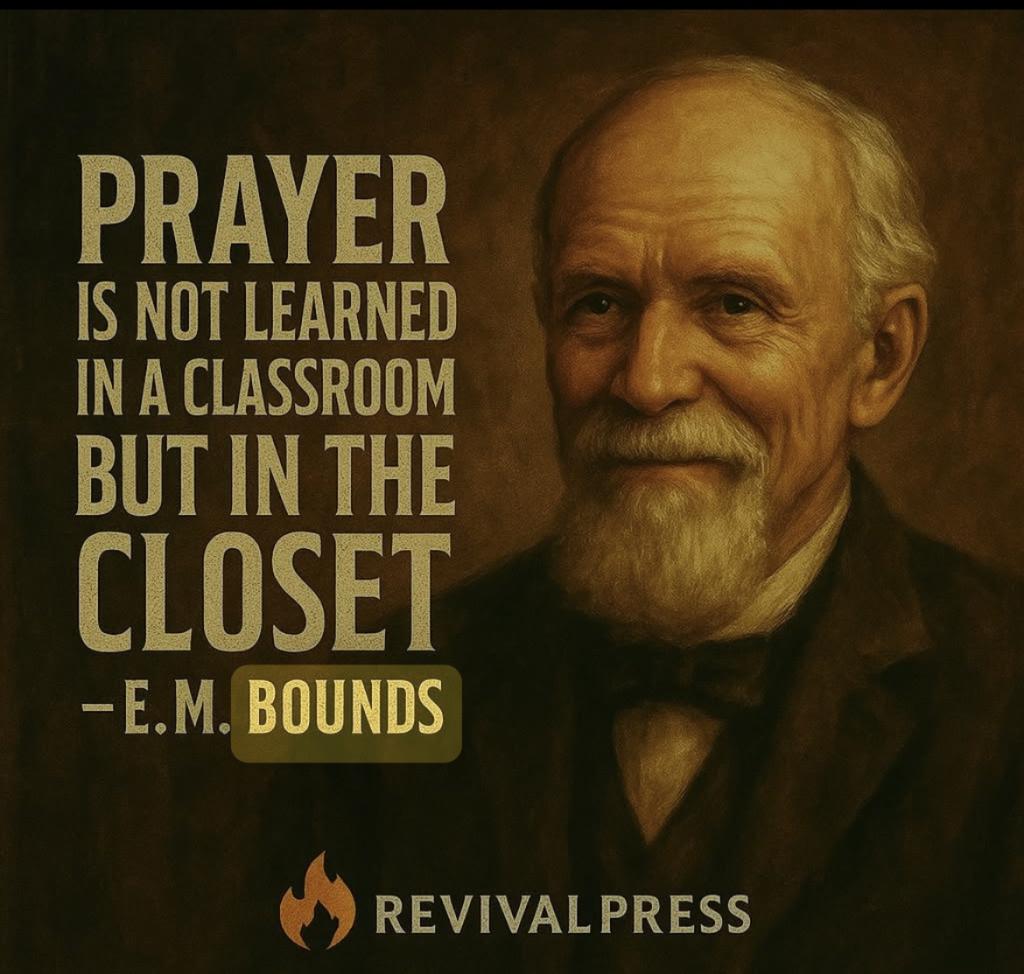
Tuesdays tip: May 26, 2026…
Progress isn’t always loud; sometimes it’s the quiet decision to keep going, to rest when you need to, and to try again tomorrow.
You don’t have to be perfect. ... View MoreTuesdays tip: May 26, 2026…
Progress isn’t always loud; sometimes it’s the quiet decision to keep going, to rest when you need to, and to try again tomorrow.
You don’t have to be perfect.
You just have to show up, one small step at a time.
And right now, the fact that you’re still here, still trying means you haven’t given up yet.
That’s something to be proud of.
The widow kept coming back in Luke 18 and the unjust judge said I don’t fear God or man, but she continually comes.
She kept coming back until the judge changed his verdict. 
Keep going. You’ve got this.
Evangelist Tim Hall
Monday Manna: May 25, 2026..
Yesterday we celebrated what we call Pentecost Sunday. Before Jesus went away he gave us the promise. I will go to the father, but I will send you the comforter.
Script... View MoreMonday Manna: May 25, 2026..
Yesterday we celebrated what we call Pentecost Sunday. Before Jesus went away he gave us the promise. I will go to the father, but I will send you the comforter.
Scripture also says Matthew 3:11 John the Baptist declared.. I indeed baptize you with water unto repentance: but he that cometh after me is mightier than I, whose shoes I am not worthy to bear: he shall baptize you with the Holy Ghost, and with fire:
I wanted to re-share about the great Cane Ridge revival
Some history about the great Cane Ridge revival that happened just outside Paris, Kentucky 225 years ago
FRIDAY, AUGUST 6, 1801—wagons and carriages bounced along narrow Kentucky roads, kicking up dust and excitement as hundreds of men, women, and children pressed toward Cane Ridge, a church about 20 miles east of Lexington. They hungered to partake in what everyone felt was sure to be an extraordinary “Communion.”
By Saturday, things were extraordinary, and the news electrified this most populous region of the state; people poured in by the thousands.
One traveler wrote a Baltimore friend that he was on his way to the “greatest meeting of its kind ever known” and that “religion has got to such a height here that people attend from a great distance; on this occasion I doubt not but there will be 10,000 people.”
He underestimated, but his miscalculation is understandable. Communions (annual three-to-five-day meetings climaxed with the Lord’s Supper) gathered people in the dozens, maybe the hundreds.
At this Cane Ridge Communion, though, sometimes 20,000 people swirled about the grounds—watching, praying, preaching, weeping, groaning, falling.
Though some stood at the edges and mocked, most left marveling at the wondrous hand of God.
The Cane Ridge Communion quickly became one of the best-reported events in American history, and according to Vanderbilt historian Paul Conkin, “arguably ... the most important religious gathering in all of American history.” It ignited the explosion of evangelical religion, which soon reached into nearly every corner of American life. For decades the prayer of camp meetings and revivals across the land was “Lord, make it like Cane Ridge.”
The “glory of scriptural religion” began to “shine forth” in Kentucky when James McGready arrived in Logan County in 1798 to pastor three small congregations: the Red River, Gaspar River, and Muddy River churches. He brought with him from North Carolina a well-deserved reputation for fiery preaching. He was a large, imposing man with piercing eyes and a voice coarse and tremulous. Barton Stone, pastor of the Cane Ridge Church, said of McGready after hearing him preach, “My mind was chained by him, and followed him closely in his rounds of heaven, earth, and hell with feelings indescribable.”
McGready’s preaching so stirred his congregations that when the Red River church sponsored its annual Communion in June 1800, the spiritual climate was charged. Local ministers were invited to participate, as were Presbyterian William McGee and his Methodist brother John, whose preaching had been exciting churches in Tennessee.
Friday, Saturday, and Sunday passed quietly and reverently—as these Presbyterian Communions were wont to go. On Monday, though, as one local minister preached, a woman who had long sought assurance for her salvation began shouting and singing. The preacher concluded his sermon, and all the ministers left the church—except for the McGee brothers. Presbyterian William sat on the floor near the pulpit and began weeping. Soon the congregation was weeping, seeking full security for salvation.
Methodist John rose to preach; a witness said he exhorted people to let “the Lord God omnipotent reign in their hearts, and to submit to him.” People began to cry and shout.
Then the woman who had first started shouting let out a shrill of anguish. Methodist John McGee, seemingly entranced, made his way to comfort her. Someone (probably his Presbyterian brother) reminded him this was a Presbyterian church; the congregation would not condone emotionalism!
Later John recalled, “I turned to go back and was near falling; the power of God was strong upon me. I turned again and, losing sight of the fear of man, I went through the house shouting and exhorting with all possible ecstasy and energy, and the floor was soon covered with the slain"—people were falling in ecstasy.
More people began arriving than could be accommodated by the host church’s families, but most came prepared to encamp. (Though large outdoor meetings had a long history, this was probably the first “camp meeting"—though the term was not coined for another two years.)
Friday and most of Saturday passed in a solemn manner, but on Saturday night, just after the last sermon was finished, two women began talking excitedly about how God had entered them, and soon, wrote McGready, “Sinners [were] lying powerless in every part of the house, praying and crying for mercy.” All night long, ministers attended to distressed and desperate penitents.
Sunday morning’s sermon also evoked groans and cries, and at night, with the pulpit illumined by flaming torches, William McGee exhorted with all the energy and oratory he could muster. “Towards the close of the sermon, the cries of the distressed arose almost as loud as his voice,” McGready wrote. “After the congregation was dismissed the solemnity increased. ... No person seemed to wish to go home—hunger and sleep seemed to affect nobody—eternal things were the vast concern.”
In the succeeding months, camp meeting revivals spread through Kentucky and Tennessee: at Muddy River, Mr. Craighead’s church, Clay-lick, Little Muddy Creek, Montgomery’s Meetinghouse, and Hopewell. Each seemed more dramatic than the last. As 1800 drew to a close, John McGee reported that at Desha’s Creek, “Many thousands of people attended.
The mighty power and mercy of God was manifested. The people fell before the Word, like corn before a storm of wind, and many rose from the dust with divine glory shining in their countenances.”
Presbyterian Barton W. Stone, pastor of the Concord and Cane Ridge churches, traveled to witness one of these revivals for himself. He returned in that spring of 1801 overwhelmed.
“The scene to me was new and passing strange. ... Many, very many fell down, as men slain in battle, and continued for hours together in an apparently breathless and motionless state—sometimes for a few moments reviving, and exhibiting symptoms of life by a deep groan, or piercing shriek, or by a prayer for mercy most fervently uttered. ...
With astonishment did I hear men, women, and children declaring the wonderful works of God.”
When he described his experiences to the Cane Ridge Church, the congregation was “affected with awful solemnity, and many returned home weeping.” That evening, when he spoke at the Concord church, two little girls fell in a faint. After a brief revival ensued at Concord, Stone scheduled a Communion at Cane Ridge the first weekend in August.
The Cane Ridge meeting house sat on the gentle slopes of a large hill covered with bamboo—the cane that gave the ridge its name—and scattered clumps of trees. The simple meeting house could hold 500 (standing room), but the congregation had recently erected a large tent, perhaps to accommodate the anticipated crowds.
But as Friday, August 6 ensued, it was clear no one had adequately anticipated the numbers. The Cane Ridge families opened their homes to the neighboring families who customarily attended the annual Cane Ridge Communion. Wealthier families might take in three or four such families; still, children and even adults had to sleep on the floor or in barns. A dozen people might sleep in a single room in a small cabin. Some thoughtful farmers left fields unpastured or left hay uncut in order to feed visitors' horses. But as the visitors grew from hundreds into thousands, local hospitality was swamped. Many visitors had to find lodging miles away, though some came prepared to camp.
Friday evening it rained, which held back the crowds, but still the meetinghouse was packed. Barton Stone, as host pastor, probably gave the opening welcome, followed by a sermon by Matthew Houston, a colleague. The air was thick with expectancy, but nothing extraordinary occurred, though some lingered all night in prayer.
Then something even more strange occurred, later to be called “the jerks.” One witness described those afflicted: “Their heads would jerk back suddenly, frequently causing them to yelp, or make some other involuntary noise. ... Sometimes the head would fly every way so quickly that their features could not be recognized. I have seen their heads fly back and forward so quickly that the hair of females would be made to crack like a carriage whip, but not very loud.”
As dark descended, camp fires cast large shadows against the trees; candles, lamps, and torches illumined the camp as hundreds moved to and fro, “like Gideon’s army"; preachers shouted sermons from the tent as people exhorted from the ground; some chanted hymns, others ecstatic hosannas—and always the mournful wailing for sin. “The noise was like the roar of Niagara,” wrote a participant. “The vast sea of human beings seemed to be agitated as if by a storm.”
The most extravagant exercises were mocked at this and later revivals, even though they were restricted to a relative few. Still, by Saturday evening, even the ministers were troubled by the tumult. None were opposed to the exercises per se, but some, like John Lyle, believed it wrong for preachers to coax such emotionalism by hysterical preaching. Lyle was especially puzzled by Barton Stone, the host pastor. He was not a wild preacher, like some, but he did nothing to restrain the wilder preachers.
The distress and confusion were so widespread even the young enthusiast McNemar was worried. Lyle, McNemar, and Matthew Houston started preaching unscheduled nighttime sermons from the tent, which helped calm the crowds. But they didn't lower the level of spiritual anxiety.
Nor could anyone get a handle on the numbers. Estimates of attendance ran between 10,000 and 25,000; estimates of the slain from 1,000 to 3,000; estimates of those who took Communion from 800 to 3,000; estimates of conversions, from 1,000 to 3,000.
This much is clear. Religion suddenly became the talk of the region and nation. Traveling to Lexington a year later, one man reported that he heard “little else than the great revival of religion.” Such was the continued enthusiasm, he said he “felt much anxiety lest I should fall down when amongst them"!
Borrowed from the Cane Ridge reader. Can’t find the original book about Cane Ridge it’s a little plain green book simply titled “Cane Ridge reader”.
This was 1801….225years ago.
My addition to this…
Don’t try to put the fire out just because you didn’t start it, Start your own.
Evangelist Tim Hall
As we “celebrate” and people have a long 3 day weekend, cookouts, fireworks and other fun things let us remember why we have the freedom to do these things.
Memorial Day is to honor all the fallen so... View MoreAs we “celebrate” and people have a long 3 day weekend, cookouts, fireworks and other fun things let us remember why we have the freedom to do these things.
Memorial Day is to honor all the fallen soldiers FALLEN who gave their lives and died on the battlefield. America is indebted for their sacrifice and we honor them this Memorial Day 2026 . . .
We also used to call it decoration day and would visit, clean, and put fresh flowers on the graves of our family members who have passed.
We honor our families who have passed as well.
My Dad and Mom are buried in Harlan Kentucky FREEDOM comes with sacrifice, it isn’t free !!!
Wishing my health would allow me to go to the graveyard this weekend.
Evangelist Tim Hall
Tim’s Sunday thought: May 24, 2026…
A “mouse” was put at the top of a jar filled with grains. He was so happy to find so much food around him that no longer he felt the need to run around searching ... View MoreTim’s Sunday thought: May 24, 2026…
A “mouse” was put at the top of a jar filled with grains. He was so happy to find so much food around him that no longer he felt the need to run around searching for food and now he could happily live his life.
After a few days of enjoying the grains, he reached the bottom of the jar. Now he was trapped and he couldn’t get out of it. He now has to solely depend upon someone to put grains in the same jar for him to survive.
He also may not get the grain of his choice and he cannot choose either.
Here are a few lessons to learn from this:
1) Short term pleasures can lead to long-term traps (living on benefits/furlough/spoiled by parents. Moses said he would rather endure the afflictions with the righteous, then enjoy the pleasures of sin for a season.
2) If things are coming easy and you are getting comfortable, you are getting trapped into dependency.
3) When you are not using your skills, you will lose more than your skills. You lose your CHOICES and FREEDOM.
4) Freedom does not come easy but can be lost very quickly.
NOTHING comes easily in life and if it comes easily, maybe it is not worth it..
Be willing to daily do as Apostle Paul said “ I die daily”. Not my will but thine be done.
Evangelist Tim Hall
Saturday’s thought: May 23, 2026….
John D. Rockfeller (July 8, 1839–May 23, 1937), the founder of Standard Oil, was once the richest man in the world. He was the world’s first billionaire. He amassed... View MoreSaturday’s thought: May 23, 2026….
John D. Rockfeller (July 8, 1839–May 23, 1937), the founder of Standard Oil, was once the richest man in the world. He was the world’s first billionaire. He amassed a net worth of at least $1 billion in 1916. When Rockefeller died in 1937, his net worth was estimated to be approximately $340 billion in today's dollars.
By the age of 25, he had one of the largest oil refineries in the United States. He was 31 when he became the world's largest oil refiner. At 38, he controlled 90% of the oil refined in the United States. At fifty, John was America's richest man. As a young man, every action, attitude, and connection was crafted to establish his wealth.
But at the age of 53, he fell unwell. His entire body became wracked with pain, and he lost all his hair. In total anguish, the world's lone millionaire could buy anything he wanted but could only eat soup and crackers.
According to an associate, "He couldn't sleep, wouldn't smile, and nothing in life meant anything to him". His personal, highly trained physicians indicated that he would die within the year. That year passed painfully slowly. As he approached death, he awoke one morning with the faint understanding that he would not be able to bring any of his fortune with him to the next world.
The man who could dominate the commercial world suddenly realised he had no control over his personal life. He informed his solicitors, accountants, and management that he intended to devote his assets to hospitals, research, and charity work. John D. Rockefeller started his foundation.
The Rockefeller Foundation financed Howard Florey and his colleague Norman Heatley's penicillin research in 1941. But arguably the most astounding aspect of Rockefeller's narrative is that when he began to give back a fraction of all he had gained, his body's chemistry changed dramatically, and he recovered.
He was expected to die at the age of 53, but he survived to reach 98 years old. Rockefeller learnt gratitude and returned the great bulk of his money. This made him whole. It's one thing to be healed. It is another to become fit. He was a devout Baptist who attended the Euclid Avenue Baptist Church in Cleveland, Ohio.
Before he died, he wrote in his diary: "God taught me that everything belongs to Him, and I am merely a conduit to carry out His will. My life has been one long, happy holiday since then; full of work and play, I let go of my worries along the road, and God was wonderful to me every day.
Evangelist Tim Hall
Borrowed
Thursdays thought: May 21, 2026..
Know Your Enemy
He is not loud.
He is not obvious. ... View MoreThursdays thought: May 21, 2026..
Know Your Enemy
He is not loud.
He is not obvious.
And he has been studying you longer than you have been studying him.
Satan patiently waited for Samson to finally tell Delilah the truth.
Satan waited until Jesus had fasted 40 days and was hungry to tempt him.
Evangelist Tim Hall
Nancy Ky
page=1&profile_user_id=5204&year=&month=
Load More