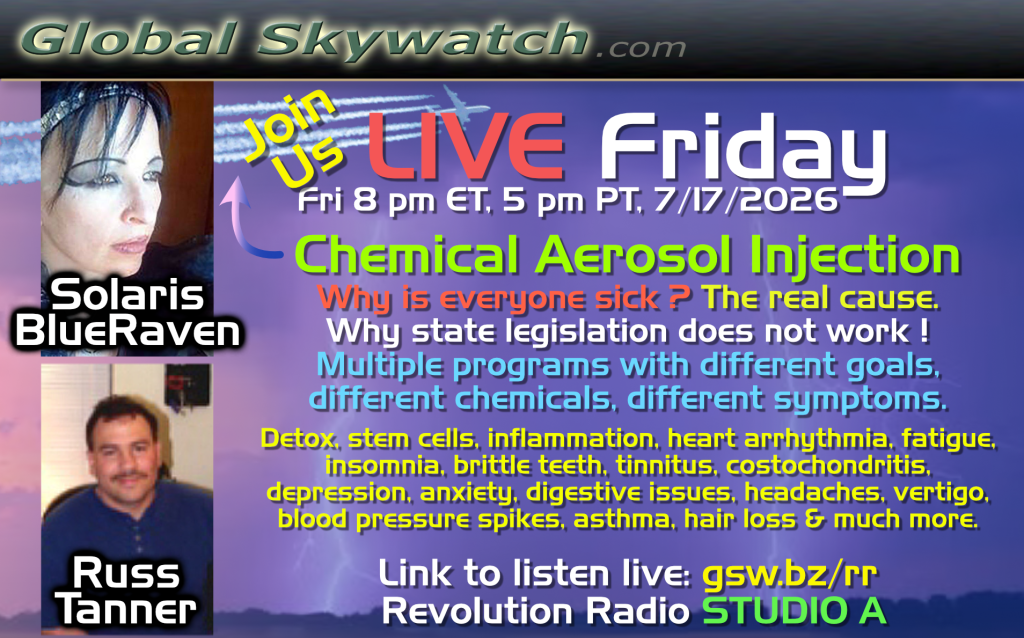
First-Time Global Skywatch Video Interview with Eerie News
We covered a lot of ground! Full interview here:
https://gsw.bz/en251023
It is stunning how precisely the "Aromatic" ( https://gsw.bz/type-aromatic )plume type matches the symptom set of cadmium exposure/poisoning. The Aromatic type has become 1 of the 2 most commonly-spra... View MoreIt is stunning how precisely the "Aromatic" ( https://gsw.bz/type-aromatic )plume type matches the symptom set of cadmium exposure/poisoning. The Aromatic type has become 1 of the 2 most commonly-sprayed types in our area (I can't speak for other areas, but it's likely the same). They use this type daily concentrating usage at night between about 10:30 pm until 2 to 4 am. Intensity has never been as strong as it is now.
I wrote a substack article on this months ago. For those who may be interested, I will share some of my personal research notes below.
Why it's not showing up "high" in your blood test
Nanoparticles are orders of magnitude more reactive/toxic because they contain orders of magnitude larger surface area per volume as compared with common (HEPA) particle sizes. This means that nanoparticles only require roughly 1/100th of the volume of exposure to produce the same symptoms/damage as common particle sizes at 100+ times the volume. This is how knowledge of nanoparticulate exposure is evaded by common lab tests.
Because Inductively Coupled Plasma Mass Spectrometry (ICP-MS)—the type of test used to measure the volume of metals in the blood—measures volume, such tests will show "normal" contaminant ranges for nanoparticles even though they are producing symptomology/damage 100+ times greater than would normally be expected by common (HEPA) particle sizes.
This fact effectively makes this type of warfare undetectable to the target using common/conventional methods of measurement.
Cadmium
- Cadmium occupies zinc binding sites
- Fulvic Acid binds cadmium
- Cd accumulates in the kidneys impairing function
- Can cause flu-like symptoms
- Yes, cadmium exposure can cause tremors:
- Cadmium is poisonous (obviously)
- Cadmium is a highly toxic element that can be fatal if ingested or inhaled.
Symptoms of cadmium exposure include tremors, headaches, drowsiness, metallic taste, loss of appetite, nausea, convulsions, and respiratory arrest.
Parkinsonism-like syndrome
Chronic exposure to cadmium can cause a Parkinsonism-like syndrome, which includes tremors, slow movement, and stiffness.
Other symptoms of cadmium exposure include:
- Insomnia
- Fatigue
- Forgetfulness
- Changes in vision and hearing
- Arm numbness
- Hand tremors
- Confusion
- Stuttering
- Tingling in head
Cadmium exposure can cause a number of symptoms, including cold hands, which can be a sign of heavy metal poisoning:
Tingling hands: A symptom of heavy metal poisoning and cadmium ingestion
Flu-like symptoms: Exposure to cadmium fumes can cause flu-like symptoms, including chills, fever, and muscle pain
Stomach irritation: Eating food or drinks contaminated with cadmium can cause stomach irritation, abdominal cramps, nausea, vomiting, and diarrhea
Numbness: A symptom of heavy metal poisoning and acute heavy metal exposure
Weakness: A symptom of heavy metal poisoning and acute heavy metal exposure
Dehydration: A symptom of heavy metal poisoning
Scratchy throat: A symptom of heavy metal poisoning
Cadmium exposure can also impair the body's ability to adapt to cold stress.
Overexposure may cause fatigue, headaches, nausea, vomiting, abdominal cramps, diarrhea and fever. In addition, progressive loss of lung function (emphysema), abnormal buildup of fluid within the lungs (pulmonary edema) and breathlessness (dyspnea) may also be present. Some affected individuals may have increased salivation; yellowing of the teeth; an unusually rapid heartbeat (tachycardia); low levels of iron within the red blood cells (anemia); bluish discoloration (cyanosis) of the skin and mucous membranes due to insufficient oxygen supply to these tissues and/or an impaired sense of smell (anosmia).
Individuals with cadmium poisoning may also experience improper functioning of the canals with the kidney (renal tubular dysfunction) characterized by excretion of abnormally high levels of protein in the urine (proteinuria), minor changes in liver function and/or softening of certain bones (osteomalacia).[Source]
Bone mineral health is sensitively related to environmental cadmium exposure- experimental and human data Source
Yes, exposure to cadmium can cause inflammation in the heart:
Inflammation-induced imbalance
Cadmium can cause an imbalance in the extracellular matrix turnover in the heart, which is linked to inflammation.
Vascular inflammation
Non-toxic levels of cadmium can stimulate the expression of MMP-2 and MMP-9 in the cardiovascular system, which can lead to vascular inflammation and atherosclerosis.
Oxidative stress
Cadmium can cause oxidative stress in the heart, which can lead to inflammation, apoptosis, and metabolic disorders.
Elevated risk of cardiovascular disease
High levels of cadmium in the blood are associated with an increased risk of cardiovascular disease.
Yes, cadmium exposure can potentially cause both digestive issues and heart arrhythmias, though these effects depend on the level and duration of exposure. Here's how cadmium might be involved in these symptoms:
Heart Arrhythmias
- Electrolyte Imbalance: Cadmium can disrupt the balance of key electrolytes such as potassium, calcium, and magnesium. These are crucial for maintaining normal electrical activity in the heart, and imbalances can lead to arrhythmias.
- Oxidative Stress: Cadmium exposure promotes oxidative stress, which can damage heart cells and disrupt their electrical conduction.
- Direct Toxicity: Cadmium interferes with calcium signaling in cardiac muscle cells, potentially causing abnormal heart rhythms.
- Hypertension: Chronic exposure to cadmium has been linked to high blood pressure, a risk factor for arrhythmias.
General Attributes of Cadmium
Considerably more thiophilic than zinc: binds aggressively to sulfur. src
Carcinogenicity: Inhalation or subcutaneous injection causes malignant tumors in rat studies. Excess zinc by inhalation, parenteral, or oral routes has been shown to reduce the carcinogenic potential of cadmium after systemic or inhalation exposure. Src
Cadmium CdS in high doses induces toxicity in both neuron and purkinje cells in rats. These are the cells that produce GABA. Is this why we feel stimulated when they spray this type? src
Solutions
Consume foods rich in iron, zinc, and calcium, which can reduce cadmium absorption.
Chelation therapy may be recommended in severe cases.
Antioxidants such as vitamins C and E can help counteract oxidative stress.
Advanced Diagnostic Tests
Chelation Challenge Test:
• Involves administering a chelating agent (e.g., EDTA or DMPS) to mobilize cadmium stored in tissues, followed by urine analysis.
• Strengths: Can indicate body burden in tissues.
• Limitations: Should only be performed under medical supervision, as it can temporarily increase circulating cadmium levels and risk toxicity.
Detox
EDTA (Ethylenediaminetetraacetic Acid)
Mechanism: Binds to heavy metals like cadmium and promotes their excretion through urine.
Use: Commonly used in clinical settings for chronic heavy metal poisoning.
Administration: Typically given intravenously (IV) under medical supervision.
Pros: Effective at reducing blood cadmium levels.
Cons: Can also chelate essential minerals like calcium and magnesium, so supplementation may be required to prevent deficiencies.
DMPS (Dimercaptopropane-1-sulfonate)
Mechanism: A sulfur-containing compound that binds cadmium, enhancing its excretion through urine.
Use: Effective for acute and chronic heavy metal poisoning, including cadmium.
Administration: Given orally, intravenously, or intramuscularly.
Pros: Strong binding affinity for cadmium and generally well-tolerated.
Cons: Should only be used under medical supervision due to potential side effects, such as kidney stress.
DMSA (Dimercaptosuccinic Acid)
Mechanism: A sulfur-based chelator that binds cadmium and enhances its elimination.
Use: FDA-approved (seriously?) for treating heavy metal poisoning, including lead, and effective for cadmium detoxification.
Administration: Typically taken orally.
Pros: Less likely to deplete essential minerals than EDTA; suitable for long-term use.
Cons: Can cause mild gastrointestinal upset or allergic reactions in some individuals.
Alpha-Lipoic Acid (ALA)
Mechanism: Acts as a mild chelator and antioxidant, helping to protect cells from cadmium-induced oxidative damage while mobilizing cadmium for excretion.
Use: Often used as a supportive agent rather than a primary chelator.
Administration: Available as an over-the-counter supplement.
Pros: Protects against oxidative stress; safe for long-term use.
Cons: Less effective as a standalone chelator.
Glutathione and N-Acetylcysteine (NAC)
Mechanism: Enhance the body’s natural detoxification processes by boosting glutathione levels, a key antioxidant and chelator.
Use: Best as a supportive therapy alongside stronger chelators.
Administration: Oral or IV (glutathione); oral (NAC).
Pros: Protects against cadmium-induced oxidative damage; safe for prolonged use.
Cons: Works better when combined with other chelators.
Selenium
Mechanism: Forms an inert complex with cadmium, reducing its toxicity and aiding its elimination.
Use: Best as a protective agent rather than a primary chelator.
Administration: Oral supplementation.
Pros: Mitigates oxidative damage and supports immune function.
Natural Chelators
Chlorella and Spirulina: Bind heavy metals in the gut and promote excretion.
Pectin (e.g., Modified Citrus Pectin): Binds cadmium in the gastrointestinal tract to reduce reabsorption.
Dietary Fiber: Binds cadmium and supports gut health.
Nutrients That Reduce Cadmium Absorption
Cadmium competes with essential minerals for absorption in the intestines. Ensuring adequate intake of these minerals can reduce cadmium uptake:
- Calcium: Supplementing calcium can limit cadmium absorption in the gut, as both compete for the same transport mechanisms.
- Zinc: Zinc competes with cadmium for absorption and helps maintain healthy cellular processes that cadmium might disrupt.
- Iron: Adequate iron reduces cadmium uptake, particularly in people with low iron stores (e.g., those with anemia).
- Magnesium: Magnesium supplementation can help maintain normal cellular function and reduce cadmium-induced damage.
Mercury and inflammation...
August 29 - The Daily Spraying Log
#thedailysprayinglog - #chemtrailsitswhatyoubreathe
This is a daily record of intentional, atmospheric particulate injection and the fallout we detect in the air and... View MoreAugust 29 - The Daily Spraying Log
#thedailysprayinglog - #chemtrailsitswhatyoubreathe
This is a daily record of intentional, atmospheric particulate injection and the fallout we detect in the air and suffer from on the ground. This log covers Bangor, Maine but is happening virtually everywhere globally.
12:11 pm
The pattern change we have experienced in the past couple weeks has been stunning. They are dominating the air with the Mercury type and the Sharp Metallic type. This is unheard of historically.
With mercury symptoms soaring, I am experiencing them as well as those I know.
You can expect a rise in emotionalism, drama, recklessness, compulsiveness, sadness, obsessiveness, and negative emotions in general. This will be reflected in the real world with more accidents, more relationship issues, and more isolation. For some, it will bring more visits to therapists. For others, it will mean more isolation or escapism. Yet for others it means more drinking and recreational drugs, anything to dull the emotional pain.
Increasing public exposure to mercury brings chaos to lives and to society in whole. This emotional chaos raises crime and general instability which helps the powers over governments legitimize governmental power grabs in the name of safety for the population.
Of course, this is all intentionally created to bring about change, namely, centralization.
Centralization is bad. It mean loss of your ability to make your own personal decisions because power is shifted to a centralized body. Loss of your freedom combined with increased governmental power means more harm and destruction, leading to more chaos leading to more centralization.
This is why mercury is the globalists' favorite poison. It is a required component in power grabs, centralization, and in the process of legitimizing global government in the eyes of the people. This is precisely why I told the world many years ago that, no matter what president was elected, the spraying will not stop. It is essential for the establishment of global government, which they will achieve "by consent or conquest".
In February 17, 1950 before the U.S. Senate Committee on Foreign Relations, Warburg said:
"We shall have world government, whether or not we like it. The question is only whether world government will be achieved by consent or by conquest." —James Paul Warburg, a German-born American banker, businessman, and writer known for being the financial adviser to Franklin D. Roosevelt, son of banker Paul Warburg, member of the Warburg family and "father" of the Federal Reserve System(1)
See https://gsw.bz/emotional
See https://gsw.bz/globalism
See https://gsw.bz/deathtrails.
See http://globalskywatch.com/illness/
Following are the events for the day so far. Notice how high mercury now appears on most of the lists. This is a sign that things are happening in the political background.
Notice also the hourly spraying. This is a huge departure of the bi-hourly spraying of a few years ago. This is how they make trails shorter, non-persistent, and in many cases, invisible.
~ 12:05 am - Hit with multi-component plume
Intensity Delta (rise-time): Medium-Fast
Peak Intensity: 10
Components (strongest to weakest):
- Neo-Inflammatory - Inflames the heart, lungs, and head.
- Inflammatory - Inflames the heart and lungs in some (dangerous).
- Mercury - Always present.
- Barium Normally sprayed before incoming precipitation
- Sedative/Magnesium-Blocker/Beta-Blocker - Cadmium? Blocks magnesium metabolism, may induce arrhythmia (dangerous).
~ 12:48 am - Hit with multi-component plume
Intensity Delta (rise-time): Medium-Fast
Peak Intensity: 8.75
Components (strongest to weakest):
- Neo-Inflammatory - Inflames the heart, lungs, and head.
- Inflammatory - Inflames the heart and lungs in some (dangerous).
- Mercury - Always present.
- Barium Normally sprayed before incoming precipitation
- Sedative/Magnesium-Blocker/Beta-Blocker - Cadmium? Blocks magnesium metabolism, may induce arrhythmia (dangerous).
~ 1:59 am - Hit with multi-component plume
Intensity Delta (rise-time): Medium-Fast
Peak Intensity: Above 10
Components (strongest to weakest):
- Neo-Inflammatory - Inflames the heart, lungs, and head.
- Inflammatory - Inflames the heart and lungs in some (dangerous).
- Mercury - Always present.
- Acid-Burn - Sinuse & lungs burn on contact, listlessness, tiredness.
- Aromatic - Heart arrhythmia, hypoxia symptoms, headaches, shortness of breath, etc.
- Sedative/Magnesium-Blocker/Beta-Blocker - Cadmium? Blocks magnesium metabolism, may induce arrhythmia (dangerous).
~ 3:01 am - Hit with multi-component plume
Intensity Delta (rise-time): Medium-Fast
Peak Intensity: Above 10
Components (strongest to weakest):
- Sharp Metallic - Produces strong mercury symptoms.
- Mercury - Always present.
- Barium Normally sprayed before incoming precipitation
~ 3:55 am - Hit with a single-component plume
Intensity Delta: Fast
Peak Intensity: 9.5
Component:
- Burnt Electronics/Skunk
Intensity through the rest of the night was between 8+ and 8.25 based on the times I was awake.
~ 10 am - Hit with multi-component plume
Intensity Delta (rise-time): Medium-Fast
Peak Intensity: 8.5
---
~ 12:10 pm - Hit with multi-component plume
Intensity Delta (rise-time): Medium-Fast
Current Intensity: Above 10, Steady
---
Components (strongest to weakest):
- Sharp Metallic - Produces strong mercury symptoms.
- Mercury - Always present.
- Aromatic - Heart arrhythmia, hypoxia symptoms, headaches, shortness of breath, etc.
- Sedative/Magnesium-Blocker/Beta-Blocker - Cadmium? Blocks magnesium metabolism, may induce arrhythmia (dangerous).
- Morgellon's - Induces sensation of getting bug bites. See link for details.
Spraying types and intensities are now more brutal than they ever have been.
page=1&callback_module_id=groups&callback_item_id=5598&year=&month=
Load More