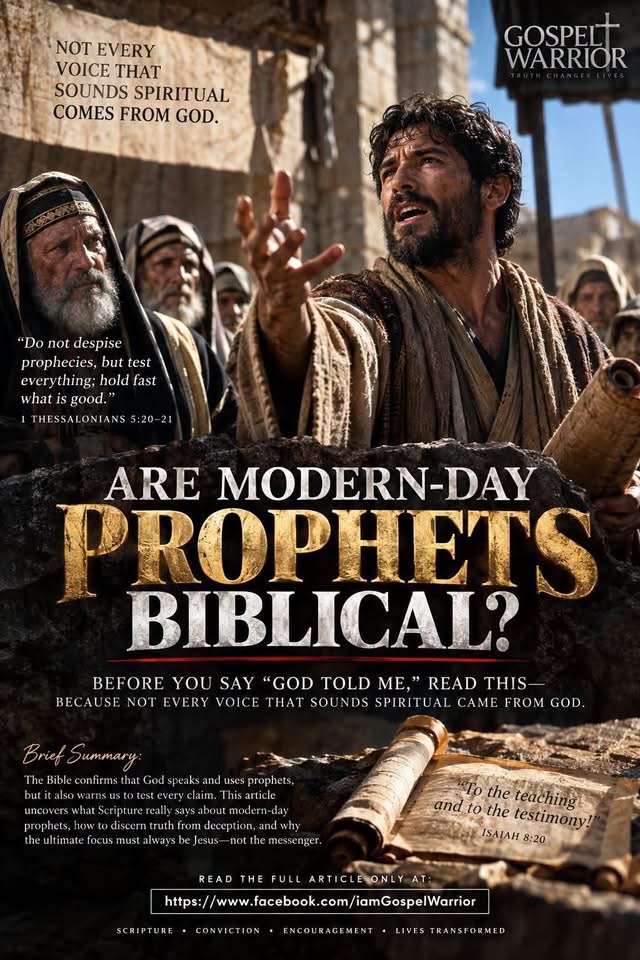
ARE MODERN-DAY PROPHETS BIBLICAL?
By John Domino Sanchez Asis
Before You Say “God Told Me,” Read This—Because Not Every Voice That Sounds Spiritual Came From God... View MoreARE MODERN-DAY PROPHETS BIBLICAL?
By John Domino Sanchez Asis
Before You Say “God Told Me,” Read This—Because Not Every Voice That Sounds Spiritual Came From God
There are few sentences more powerful in Christian circles than these:
“God told me.”
Four words.
And suddenly the conversation changes.
Because how do you argue with God?
Someone says, “God told me you should marry me.”
“God told me to start this ministry.”
“God told me you need to give.”
“God showed me what is going to happen.”
“The Lord told me what you need to do.”
And sometimes the person speaking may sincerely believe it.
Sometimes they may even be right about something.
But sincerity is not Scripture.
Accuracy alone is not proof of divine authority.
Charisma is not confirmation.
A large following is not confirmation.
A title is not confirmation.
And saying “Thus says the Lord” does not automatically mean the Lord said anything.
That is precisely why this question matters.
Are modern-day prophets biblical?
The answer requires more care than a quick “yes” or “no,” because faithful Christians who affirm the full authority of Scripture have reached different conclusions about whether the New Testament gift of prophecy continues today.
But there is something Christians on every side of that debate desperately need to remember:
God never commands His people to surrender discernment.
He commands us to use it.
Paul wrote:
“Do not despise prophecies, but test everything; hold fast what is good.”
—1 Thessalonians 5:20–21
The Greek is striking.
“Prophecies” is προφητείας (prophēteias).
And “test” comes from δοκιμάζω (dokimazō)—to examine, test, prove, or determine genuineness.
In other words, biblical faith is not gullibility dressed in Christian vocabulary.
The church is not commanded to believe every supernatural claim.
We are commanded to test.
And that becomes uncomfortable when the person claiming divine revelation is someone we admire.
Someone with a microphone.
Someone with millions of views.
Someone who seems unusually spiritual.
Someone whose conference fills stadiums.
Someone whose predictions occasionally appear astonishing.
Or perhaps someone sitting across from you at church saying quietly:
“God gave me a word for you.”
The moment somebody claims to speak for God, the stakes become enormous.
Because throughout Scripture, God takes His words seriously.
Very seriously.
Jeremiah lived among people who claimed divine revelation while speaking from their own imagination.
God said:
“I have heard what the prophets have said who prophesy lies in my name, saying, ‘I have dreamed, I have dreamed!’”
—Jeremiah 23:25
Then comes a chilling description:
“Let the prophet who has a dream tell the dream, but let him who has my word speak my word faithfully.”
—Jeremiah 23:28
That distinction still matters.
There is an enormous difference between:
“I think God may be leading me…”
and:
“God said.”
One leaves room for human fallibility.
The other invokes divine authority.
And we should tremble before casually putting words into the mouth of the Almighty.
The Old Testament Hebrew word commonly translated “prophet” is נָבִיא (nāḇîʾ).
Biblical prophets were not simply motivational speakers with spiritual intuition.
They were commissioned messengers.
Again and again Scripture introduces prophetic revelation with words equivalent to:
“Thus says the LORD.”
כֹּה אָמַר יְהוָה
Ko amar YHWH.
“Thus says the LORD.”
That is not branding.
That is authority.
And Scripture gives severe warnings about falsely claiming that authority.
Deuteronomy 18 warns Israel about the prophet who presumptuously speaks a word God has not commanded.
Jeremiah condemns prophets who speak “visions of their own minds, not from the mouth of the LORD.”
Ezekiel speaks against those who “follow their own spirit, and have seen nothing.”
That should make every Christian slow down before saying:
“God told me.”
But now we come to the New Testament.
Because something extraordinary happens.
At Pentecost, Peter explains the outpouring of the Holy Spirit by quoting the prophet Joel:
“And in the last days it shall be, God declares, that I will pour out my Spirit on all flesh…”
Then:
“your sons and your daughters shall prophesy…”
—Acts 2:17
Later, Acts describes prophets in the early church.
Agabus is specifically named.
Acts 13 mentions “prophets and teachers” at Antioch.
Acts 21 tells us that Philip the evangelist had four unmarried daughters “who prophesied.”
Paul discusses prophecy extensively in 1 Corinthians 12–14.
So Christians cannot honestly pretend prophecy disappears the moment we turn the page from Malachi to Matthew.
It is clearly present in the New Testament church.
But neither may we simply assume that every person today calling himself or herself “Prophet” possesses the same authority as Isaiah, Jeremiah, Ezekiel, Peter, Paul, or the foundational witnesses through whom God gave Scripture.
That is where discernment becomes essential.
Paul writes that the church was:
“built on the foundation of the apostles and prophets, Christ Jesus himself being the cornerstone.”
—Ephesians 2:20
Notice the imagery.
Foundation.
A foundation is laid.
Jesus Christ remains the cornerstone.
The apostles occupied a unique, foundational role in redemptive history.
And whatever position Christians take concerning contemporary prophecy, nobody today gets to write another Gospel of Matthew.
Nobody gets to add another chapter to Romans.
Nobody gets to stand beside Scripture and announce:
“My revelation carries equal authority.”
The canon is not waiting for your favorite preacher's sequel.
Scripture remains the measuring line.
This is why Isaiah's ancient words remain so relevant:
“To the teaching and to the testimony!”
—Isaiah 8:20
And why Paul could tell Timothy that the sacred writings are able to make him “wise for salvation through faith in Christ Jesus,” before declaring:
“All Scripture is breathed out by God…”
—2 Timothy 3:16
The Greek word translated “breathed out by God” is θεόπνευστος (theopneustos).
God-breathed.
That is an extraordinary category.
Your impressions are not theopneustos.
My feelings are not theopneustos.
A preacher's dream is not automatically theopneustos.
A viral prophecy is not theopneustos.
Scripture is.
And this distinction could save someone from enormous spiritual damage.
Because perhaps you have been wounded by someone who weaponized the phrase:
“God told me.”
Maybe somebody manipulated you with prophecy.
Maybe someone predicted something that never happened, then quietly changed the explanation afterward.
Maybe someone used spiritual authority to control your relationship.
Your money.
Your decisions.
Your conscience.
Maybe you were afraid to question them because you thought questioning them meant questioning God.
Listen carefully.
Testing a claimed revelation is not rebellion against God.
God Himself tells you to test.
The apostle John writes:
“Beloved, do not believe every spirit, but test the spirits to see whether they are from God…”
—1 John 4:1
Why?
“For many false prophets have gone out into the world.”
John did not say:
Believe everything supernatural.
He said:
Test it.
And his immediate test is profoundly Christ-centered.
What does this message say about Jesus Christ?
Because biblical prophecy never exists to make the prophet the star.
The Spirit glorifies Christ.
Jesus said concerning the Holy Spirit:
“He will glorify me.”
—John 16:14
That single truth exposes much of what passes for spirituality.
If someone's “prophetic ministry” constantly makes you obsessed with the prophet instead of Christ…
Be careful.
If you need their next livestream more desperately than you need Scripture…
Be careful.
If questioning their words is treated as questioning God…
Be careful.
If every revelation somehow ends with money flowing toward them…
Be careful.
If Jesus becomes background scenery while the personality on the stage becomes indispensable…
Something has gone terribly wrong.
The Holy Spirit does not come to build celebrity kingdoms.
He glorifies Jesus.
And here we must deal fairly with an important disagreement among Bible-believing Christians.
Some Christians are cessationists. Broadly speaking, they believe certain revelatory or sign gifts associated with the apostolic era no longer function in the church in the same way after the foundational apostolic period.
Other Christians are continuationists. They believe gifts such as prophecy continue, while insisting that contemporary prophetic impressions must be tested and cannot rival, correct, supplement, or override Scripture.
There are thoughtful, Christ-loving Christians on both sides.
So this article will not pretend a centuries-old theological discussion can be solved with a slogan.
But whichever position you hold, Scripture gives boundaries that cannot safely be ignored.
No modern revelation outranks Scripture.
No prophecy may contradict the Gospel.
No prophet becomes spiritually untouchable.
No supernatural manifestation proves by itself that God authorized the messenger.
No Christian should surrender conscience and biblical discernment to someone merely because that person claims divine revelation.
And Jesus Himself gave us an even more frightening warning.
“False christs and false prophets will arise and perform great signs and wonders…”
—Matthew 24:24
Think about that.
Jesus did not say deception would always look ridiculous.
Sometimes deception looks supernatural.
That means “something incredible happened” is not enough.
Signs are not the ultimate test.
Jesus is.
Truth is.
Scripture is.
The Gospel is.
Character matters too.
Jesus said:
“You will recognize them by their fruits.”
—Matthew 7:16
Not merely by their predictions.
Not by their followers.
Not by their stage presence.
Fruit.
And what does the Spirit produce?
“Love, joy, peace, patience, kindness, goodness, faithfulness, gentleness, self-control.”
—Galatians 5:22–23
So perhaps the question should not merely be:
“Can this prophet tell me something about my future?”
Perhaps we should also ask:
Does this ministry make much of Christ?
Does it honor Scripture?
Does it produce repentance?
Does it display humility?
Is there accountability?
Can the leader be questioned?
Are failed claims acknowledged honestly?
Is money handled transparently?
Does the teaching lead people toward Jesus—or dependence upon the prophet?
Because there is something more important than knowing what will happen next Tuesday.
Knowing Christ.
We sometimes become so desperate for a word about tomorrow that we neglect the Word God has already given us today.
We want God to tell us who we will marry.
Meanwhile Scripture tells us how to love.
We want God to reveal our next career move.
Meanwhile Scripture tells us to work faithfully and honestly.
We want a prophecy about financial breakthrough.
Meanwhile Jesus warns us about greed.
We want someone to reveal our destiny.
Meanwhile Jesus says:
“Follow me.”
Maybe the most neglected revelation in some Christian lives is the Bible sitting unopened beside the bed.
And perhaps that hurts because we would rather receive a mysterious secret than obey a clear command.
“Forgive.”
We want another word.
“Repent.”
Another prophecy.
“Love your enemies.”
Something deeper, Lord.
“Take up your cross and follow me.”
And suddenly the problem is not that God has been silent.
The problem is that what He has already said costs us something.
That is where this conversation stops being about famous prophets on the internet.
Now it becomes about us.
Because there is another danger hiding underneath our obsession with prophetic voices.
Sometimes we want certainty more than we want God.
We are terrified of making the wrong decision.
Terrified of tomorrow.
Terrified of losing someone.
Terrified of suffering.
So when someone appears and says, “God showed me your future,” something inside us desperately wants to believe.
Not necessarily because we love truth.
Because we hate uncertainty.
And that fear can make us vulnerable.
But Christianity was never an invitation to control tomorrow.
It was an invitation to trust Jesus with tomorrow.
Faith does not mean knowing everything that is coming.
Faith means knowing the One who will still be there when it comes.
Maybe nobody has a prophetic word about your next five years.
Jesus is still Lord.
Maybe you do not know whether the door will open.
Jesus is still Lord.
Maybe your prayer has not been answered the way you hoped.
Jesus is still Lord.
Maybe the diagnosis frightened you.
Jesus is still Lord.
Maybe someone you trusted failed you.
Jesus is still Lord.
Maybe a preacher disappointed you.
Jesus is still Lord.
Maybe somebody once spoke “God's will” over your life and those words became chains around your soul.
Jesus is still Lord.
And Jesus did not die so that another human being could become the mediator you cannot live without.
“For there is one God, and there is one mediator between God and men, the man Christ Jesus.”
—1 Timothy 2:5
One mediator.
Jesus Christ.
This is where scandal becomes grace.
Because Scripture is filled with people whose lives looked finished.
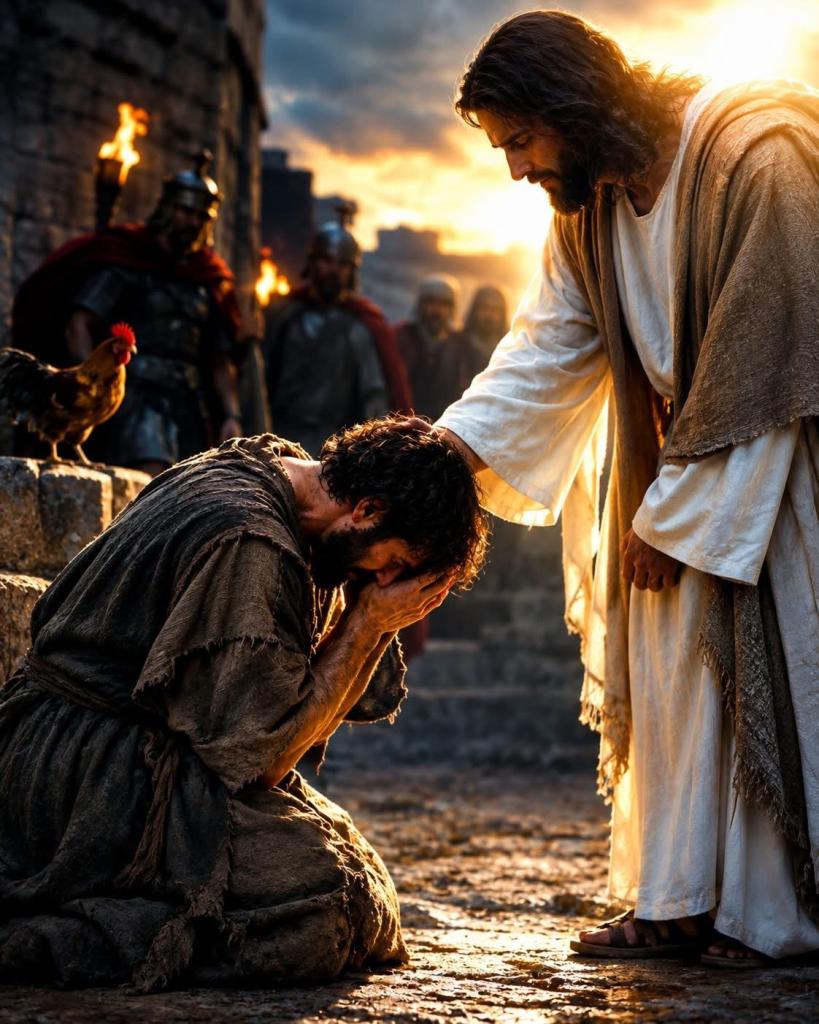
Peter denied Jesus.
Three times.
Scandal.
Then the risen Christ restored him.
Grace.
Paul persecuted Christians.
Scandal.
Then Jesus confronted him, saved him, and transformed the persecutor into a preacher of the faith he once tried to destroy.
Grace.
The Samaritan woman's history was complicated and exposed.
Scandal.
Then she encountered Jesus and ran toward the very people she might once have avoided.
Grace.
The thief beside Jesus had no lifetime left to repair his reputation.
Scandal.
Then he turned toward the crucified King and heard words of paradise.
Grace.
That is the Gospel.
Not humanity climbing high enough to become impressive to God.
God coming down in Jesus Christ to rescue sinners who could never rescue themselves.
The greatest message Christianity has for you is not:
“A prophet knows your future.”
It is:
Jesus Christ died for sinners and rose again.
That is the announcement that shattered history.
That is the message demons hate.
That is the hope death cannot swallow.
That is the Word your shame cannot cancel.
Christ crucified.
Christ risen.
Christ reigning.
Christ returning.
And if you have spent years chasing spiritual experiences while quietly running from Jesus, come home.
If your Bible has gathered dust while prophetic videos filled your history, come home.
If you have made an idol out of a minister, come home.
If someone manipulated you in God's name and you became afraid of Christianity itself, look beyond the person who wounded you and look again at Christ.
If you have claimed “God told me” when, deep inside, you knew it was your own desire speaking…
Repent.
There is grace even here.
Because repentance is not God's invitation to humiliation without hope.
It is His call out of darkness.
The Greek New Testament uses μετάνοια (metanoia) for repentance—the language of a changed mind and turning that bears fruit in a changed direction.
Jesus does not expose sin merely to crush sinners.
He exposes darkness so we can stop hiding in it.
And maybe this article has exposed something.
Maybe you have followed voices more closely than you have followed Jesus.
Maybe you trusted personalities because reading Scripture for yourself felt harder.
Maybe someone told you what you desperately wanted to hear.
Maybe you have secretly been afraid that without a “prophetic word,” God will forget you.
He has not forgotten you.
You do not need spiritual theatrics to convince Jesus that you exist.
He knows your name.
He knows the sin you hide.
He knows the wound nobody sees.
He knows why you keep smiling when your soul feels exhausted.
He knows the questions you are afraid to say aloud.
And He still calls sinners to Himself.
Not to a personality.
Not to a platform.
Not to a prophetic celebrity.
To Himself.
Jesus said:
“Come to me…”
—Matthew 11:28
That invitation still stands.
Come to Christ.
Bring your questions.
Bring your disappointment.
Bring your skepticism.
Bring your wounds from church.
Bring your hidden sin.
Bring the parts of your story you wish could be deleted.
Bring the scandal.
Because Jesus specializes in rewriting stories that looked finished.
Not by pretending sin never mattered.
By paying for sin with His own blood.
At the cross, grace was not cheap.
It cost Christ everything.
And the resurrection announces that sin, Satan, shame, and death do not get the final sentence.
Jesus does.
So are modern-day prophets biblical?
Scripture unquestionably records prophecy as a genuine work of God and a gift present in the New Testament church. Faithful Christians disagree about whether and in what sense that gift continues today.
But Scripture leaves us no permission to be undiscerning.
Test every claim.
Hold tightly to Scripture.
Reject anything contradicting God's revealed Word and the apostolic Gospel.
Look at fruit.
Beware spiritual manipulation.
Never elevate a human messenger above Jesus.
And never let someone's claim of private revelation steal the authority belonging to God's written Word.
Perhaps the safest sentence some Christians could learn again is not:
“God told me.”
But:
“Scripture says.”
Then open the Bible.
Read it in context.
Handle it faithfully.
And point people toward Christ.
If this exposed something you have been afraid to admit, do not hide behind religious language.
Comment “no more hiding.”
If you have been spiritually exhausted and you need believers to stand with you, comment “pray for me.”
If Christ has been patiently pulling you back after disappointment, confusion, failure, or deception, comment “Christ is still healing me.”
And if you have ever been manipulated by someone claiming to speak for God, you do not have to tell strangers every detail of your wound. But you can simply say, “Jesus, lead me into truth.”
Someone reading the comments may realize they are not alone.
Save this article.
Not because every sentence here deserves unquestioned acceptance—it does not.
Save it because the Scriptures cited here deserve to be opened again, studied carefully, and tested in context.
Share this article on your Facebook profile if you believe someone in your circle needs permission to test spiritual claims without feeling guilty for doing so.
Tag the friend who loves Jesus but has been confused by competing prophetic voices.
Send it privately to the person who has quietly wondered, “Am I allowed to question this?”
Yes.
Open the Bible together.
Test everything.
Keep Christ at the center.
And if Gospel Warrior has helped you return to Scripture, follow the page and invite your family, friends, struggling believers, seekers, lukewarm Christians, and even unbelieving friends to follow too. We want this community to be a place of daily Scripture, conviction, encouragement, biblical truth, healing, discipleship, and spiritual nourishment—not personality worship.
And if you want to help this work continue, subscription is one practical way to stand behind it.
Not because subscribing earns favor with God.
It does not.
Not because giving money proves that you love Jesus.
It does not.
The Gospel cannot be purchased.
But if you desire to glorify God by helping biblical, Christ-centered teaching reach more people, you can support Gospel Warrior voluntarily by subscribing and by sharing articles like this on your Facebook profile so others can encounter the message of Jesus.
Subscribers also receive a 50% discount, as our thank-you, on eligible Gospel Warrior products such as books, T-shirts, mugs, journals, and more, subject to the terms and availability of the applicable offer.
The Gospel Warrior Library also contains thousands of FREE Christian ebooks, devotionals, and discipleship resources, with new additions being added almost daily for believers serious about growing deeper in Jesus Christ.
If that is the kind of discipleship you want to help sustain—and the kind of Gospel-centered content you want to keep close—you can subscribe here:
https://www.facebook.com/iamGospelWarrior/subscribenow
But whether you ever subscribe or purchase anything, hear this clearly:
Jesus is not for sale.
Grace is not merchandise.
Salvation is not a membership benefit.
“For by grace you have been saved through faith.”
—Ephesians 2:8
Your greatest need is not access to another prophet.
Your greatest need is Christ.
So open your Bible.
Test the voices.
Refuse manipulation.
Repent when you are wrong.
Forgive where Christ calls you to forgive.
Hold fast to what is good.
And follow Jesus even when nobody can tell you exactly what tomorrow holds.
Because you do not need to know every detail of tomorrow when you belong to the One who already stands there.
And when every other voice eventually falls silent, there is still one voice your soul cannot afford to miss:
The voice of the Shepherd calling you home.
From Scandal to Grace, Because Jesus Rewrites Everything
CAN A PERSON BE FORGIVEN AFTER DENYING JESUS CHRIST?
By Very Agent Of Change
One of the most frightening questions a Christian can ask is this:... View MoreCAN A PERSON BE FORGIVEN AFTER DENYING JESUS CHRIST?
By Very Agent Of Change
One of the most frightening questions a Christian can ask is this:
“What happens if someone denies Jesus Christ?”
Does denying Christ mean there is no way back?
Can a person who once confessed Jesus later deny Him and still receive forgiveness?
The Bible gives us a powerful answer, and the story of Peter is one of the clearest places to see it.
1. PETER DENIED JESUS
Peter was not an unbeliever who had never known Jesus.
He had walked with Jesus.
He had seen miracles.
He had heard His teachings.
He had confessed that Jesus was the Christ.
Yet when Jesus was arrested, Peter became afraid.
Three times Peter denied knowing Jesus.
Matthew 26:74 says:
“Then began he to curse and to swear, saying, I know not the man.”
Think about that.
Peter had personally walked with Jesus, yet under pressure, he denied Him.
2. JESUS HAD ALREADY WARNED PETER
Before Peter denied Him, Jesus had already told him what was coming.
Luke 22:31 to 32 says:
“And the Lord said, Simon, Simon, behold, Satan hath desired to have you, that he may sift you as wheat:
But I have prayed for thee, that thy faith fail not: and when thou art converted, strengthen thy brethren.”
Jesus knew Peter would fall.
But Jesus also knew Peter would return.
This is powerful.
A moment of failure does not have to become the end of your story.
3. PETER WEPT BITTERLY
After Peter realized what he had done, he went out and wept bitterly.
Matthew 26:75 says:
“And he went out, and wept bitterly.”
Peter did not celebrate his denial.
He did not defend what he had done.
He was broken by it.
There is a difference between falling into sin and becoming comfortable with sin.
A repentant heart does not run away from God.
It runs back to God.
4. JESUS DID NOT ABANDON PETER
After the resurrection, Jesus did not tell the disciples to forget Peter.
In fact, the angel specifically mentioned Peter.
Mark 16:7 says:
“But go your way, tell his disciples and Peter that he goeth before you into Galilee.”
And why specifically mention Peter?
Because Peter needed to know that his failure had not erased him from the story.
The man who denied Jesus was still being called back to Jesus.
That should give hope to anyone who has genuinely repented of their failure.
5. JESUS RESTORED PETER
In John 21, Jesus asked Peter three times:
“Lovest thou me?”
Peter had denied Jesus three times.
Now Jesus gave Peter an opportunity to affirm his love three times.
Then Jesus told him:
“Feed my sheep.”
John 21:17
Jesus did not merely forgive Peter.
He restored him to purpose.
This is one of the most beautiful pictures of restoration in Scripture.
Your failure may have wounded you, but failure does not have to become your identity.
6. BUT WHAT ABOUT JESUS SAYING HE WILL DENY THOSE WHO DENY HIM?
Jesus said in Matthew 10:33:
“But whosoever shall deny me before men, him will I also deny before my Father which is in heaven.”
That is a serious warning.
Jesus does not want us to be ashamed of Him.
He calls His followers to stand for Him even when it is difficult.
But Peter's story shows us something important.
There is a difference between a person who fails under pressure, realizes their sin, repents, and returns to Christ, and someone who deliberately and permanently rejects Christ without repentance.
Peter fell.
Peter wept.
Peter returned.
Peter was restored.
7. DENIAL SHOULD NEVER BECOME A LIFESTYLE
We should never use Peter's story as an excuse to deny Christ.
Peter's restoration does not mean denial is acceptable.
It shows us the mercy of God toward the person who truly repents.
The message is not:
“Deny Jesus because He will forgive you anyway.”
The message is:
“If you have fallen, do not run away from Jesus. Come back to Him.”
8. WHAT IF YOU HAVE FAILED JESUS?
Maybe you once professed Christ but later became ashamed of Him.
Maybe you compromised your faith because of pressure.
Maybe you made decisions you deeply regret.
Maybe you walked away from God for a season.
Do not allow shame to tell you that there is no way back.
If you are genuinely repentant, turn back to Christ.
Confess your sin.
Ask for forgiveness.
Return to His Word.
Return to prayer.
Return to obedience.
Do not let your worst moment become your final chapter.
9. THE GOSPEL IS ABOUT RESTORATION
Peter's story reminds us that Jesus is not only the Saviour of people who have never failed.
He is also the Saviour who restores those who sincerely return to Him.
1 John 1:9 says:
“If we confess our sins, he is faithful and just to forgive us our sins, and to cleanse us from all unrighteousness.”
That is the hope of the Gospel.
Peter denied Jesus.
But Peter did not remain in his denial.
He repented.
He returned.
He was restored.
And the same Peter who once denied Jesus later boldly preached Christ.
Acts 4:20 says:
“For we cannot but speak the things which we have seen and heard.”
What a transformation.
The man who once said, “I know not the man,” became a man who could no longer remain silent about Jesus.
So if you have failed Christ, do not run from Him.
Run back to Him.
If you have denied Him, repent.
If you have fallen, rise again.
If you have wandered away, return.
Your failure does not have to be your final chapter.
Jesus is still calling people back to Himself.
Have you ever wondered whether someone who denied Jesus can truly be forgiven?
What do you learn from Peter's restoration?
Let us reason together from the Word of God.
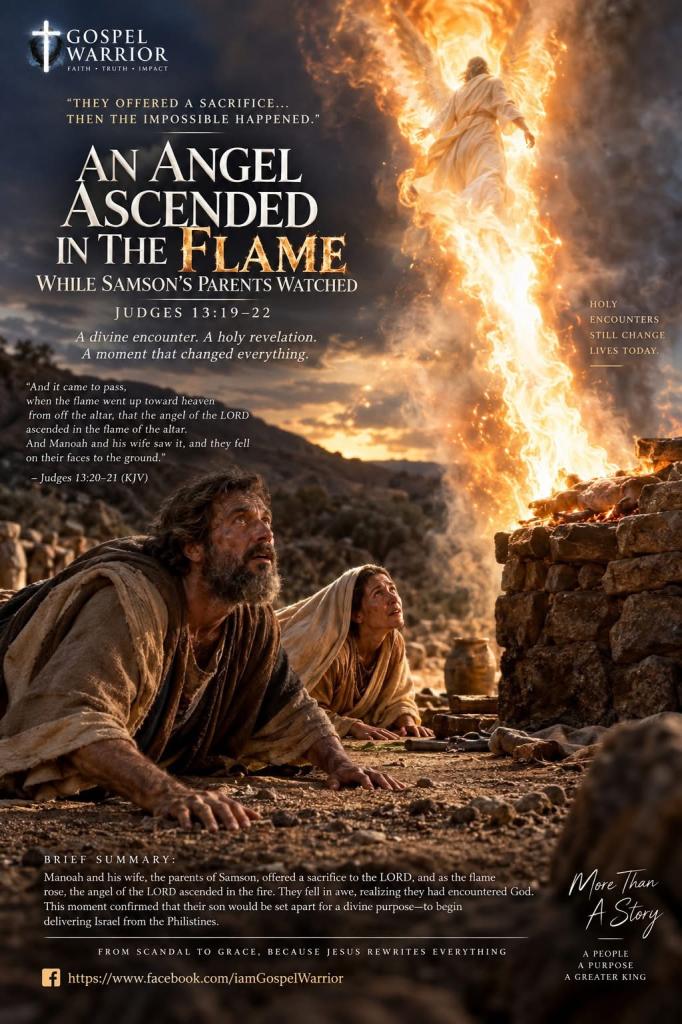
AN ANGEL WENT UP IN THE FIRE—AND SAMSON’S PARENTS REALIZED WHO HAD BEEN STANDING BEFORE THEM
By John Domino Sanchez Asis
They thought they were preparing an offering. Then the fire rose. The Messeng... View MoreAN ANGEL WENT UP IN THE FIRE—AND SAMSON’S PARENTS REALIZED WHO HAD BEEN STANDING BEFORE THEM
By John Domino Sanchez Asis
They thought they were preparing an offering. Then the fire rose. The Messenger ascended in the flame. And suddenly Manoah realized that the stranger standing in front of them had brought them terrifyingly close to the presence of God.
There are moments in Scripture that almost demand that you slow down.
Not because the passage is difficult.
Because it is terrifyingly beautiful.
Judges 13 contains one of them.
A husband and wife are standing near an altar. A young goat has been offered. Fire is rising toward heaven. They are watching the sacrifice burn when something happens that no ordinary human explanation can contain.
The Messenger of the LORD goes up in the flame.
Manoah and his wife collapse with their faces toward the ground.
And when Manoah finally understands something of what he has witnessed, his response is not excitement.
It is terror.
“We shall surely die, because we have seen God.”
But what makes this scene even more powerful is what happened before the fire.
Because this story begins with something painfully human.
Barrenness.
Waiting.
Silence.
Israel had again done evil in the sight of the LORD, and God had delivered them into the hand of the Philistines for forty years. Then the biblical camera, so to speak, moves away from the nation and enters one household.
A man named Manoah.
A woman whose personal name the text never gives us.
And an emptiness they could not repair.
Judges 13:2 describes her with the Hebrew words:
וְאִשְׁתּוֹ עֲקָרָה וְלֹא יָלָדָה
ve’ishto ‘aqarah velo yaladah
“His wife was barren and had not borne [children].”
That sentence is brutally simple.
No sentimental explanation.
No attempt to soften it.
She was barren.
She had not borne a child.
And perhaps that is where somebody reading this needs to stop for a moment.
Because you know what it feels like when one sentence seems to describe an entire season of your life.
Still waiting.
Still grieving.
Still praying.
Still fighting temptation.
Still carrying the marriage.
Still trying to forgive.
Still asking God why.
Still opening Scripture when part of you feels numb.
Still showing up at church while quietly wondering why heaven seems silent.
People see your face.
God sees the barren places.
People see what you post.
God sees what you cry about when nobody is watching.
People hear your testimony after the breakthrough.
God was there before the breakthrough had a name.
And into the barren place of Manoah’s wife came a Messenger.
Judges 13:3 says:
וַיֵּרָא מַלְאַךְ־יְהוָה אֶל־הָאִשָּׁה
vayyera mal’akh-YHWH el-ha’ishah
“And the angel of the LORD appeared to the woman.”
The Hebrew expression מַלְאַךְ־יְהוָה, mal’akh YHWH, means “messenger of the LORD” or “angel of the LORD.”
And his announcement is astonishing.
She will conceive.
She will bear a son.
The barren woman is about to become a mother.
But this is not merely a sentimental story about receiving what you desperately wanted.
The child will belong to a divine purpose.
The boy will be Samson.
Before Samson ever tears apart a lion…
before the riddles…
before the gates of Gaza…
before Delilah…
before his hair is cut…
before his eyes are gouged out…
before that final prayer beneath a Philistine temple…
there is this.
A mother.
A father.
An altar.
A flame.
And a holy calling announced before the child has even taken his first breath.
The Messenger tells the woman that the child is to be a Nazirite to God from the womb and that “he shall begin to save Israel from the hand of the Philistines.”
Notice the word.
Begin.
Samson would not complete Israel’s deliverance.
He would begin it.
Even the strongest man in the story would not be the ultimate Savior.
That matters.
Because one of the great temptations of the human heart is to expect human beings to carry a weight that belongs only to God.
We look for a Samson.
Someone strong enough.
Charismatic enough.
Powerful enough.
Talented enough.
Connected enough.
Spiritual enough.
But Samson’s own life will eventually prove that extraordinary gifting does not make a human being a perfect savior.
Samson could defeat Philistines and still struggle to govern Samson.
He could carry gates and still carry destructive desires.
He could possess supernatural strength while making catastrophically weak choices.
That is one reason the Gospel becomes so beautiful when we read the whole biblical story.
We did not ultimately need another Samson.
We needed Jesus Christ.
Not merely someone who could defeat enemies outside us, but the Savior who could deal with the sin inside us.
Not merely someone who could break physical chains, but One who could break the dominion of sin.
Not merely someone who would begin a temporary deliverance, but the Son of God who could accomplish redemption through His death and resurrection.
But Manoah does not know Samson’s whole story yet.
At this moment, he is simply a man trying to understand what God has said.
So Manoah prays.
And God listens.
The Messenger returns, and eventually Manoah asks Him to stay while they prepare a young goat.
Then comes a detail that is easy to read too quickly.
The Messenger tells Manoah that if he prepares a burnt offering, he must offer it to the LORD.
The sacrifice belongs to God.
The worship belongs to God.
The glory belongs to God.
Then Manoah asks the Messenger His name.
The response is mysterious.
Judges 13:18 records:
לָמָּה זֶּה תִשְׁאַל לִשְׁמִי וְהוּא־פֶלִאי
lammah zeh tish’al lishmi, vehu peli
“Why do you ask my name, seeing it is wonderful?”
The final Hebrew word is פֶלִאי, peli.
Translations render the idea in ways such as “wonderful,” “beyond understanding,” or “secret,” reflecting something extraordinary or incomprehensible about the name.
The text is preparing us.
Something is about to happen.
Manoah takes the young goat and the grain offering and offers them upon the rock to the LORD.
Then Judges gives us this remarkable statement:
וּמַפְלִא לַעֲשׂוֹת
umafli la‘asot
“And He did wondrously.”
Manoah and his wife are watching.
The sacrifice is burning.
Smoke rises.
Flame reaches upward.
And then—
the impossible happens.
Judges 13:20 says:
וַיְהִי בַעֲלוֹת הַלַּהַב מֵעַל הַמִּזְבֵּחַ הַשָּׁמַיְמָה וַיַּעַל מַלְאַךְ־יְהוָה בְּלַהַב הַמִּזְבֵּחַ
Vayehi va‘alot hallahav me‘al hammizbeach hashshamaymah, vaya‘al mal’akh-YHWH belahav hammizbeach.
“And it came to pass, when the flame went up toward heaven from off the altar, that the angel of the LORD ascended in the flame of the altar.”
Imagine being there.
Not reading it.
Watching it.
You smell the sacrifice.
You feel the heat.
The flames move upward.
And the mysterious Messenger who has been speaking to you steps into the very movement of the fire and ascends.
No ordinary farewell.
No walking into the distance.
No disappearing behind a hill.
Up.
In the flame.
Toward heaven.
Manoah and his wife see it.
And they fall facedown.
The Hebrew says:
וַיִּפְּלוּ עַל־פְּנֵיהֶם אָרְצָה
vayyippelu ‘al-peneihem artsah
“They fell on their faces to the ground.”
Suddenly there is no casual conversation.
No theological curiosity.
No comfortable distance.
They are on the ground.
And perhaps we have become so familiar with holy things that we have forgotten how astonishing holiness is.
We can say “God” casually.
Sing worship songs while thinking about something else.
Read verses while scrolling between notifications.
Say “Jesus” without considering the glory of the One whose name we speak.
But Manoah and his wife have just witnessed something that shattered casualness.
Fire rose.
The Messenger ascended.
They fell.
And then Manoah realizes the encounter was far more significant than he first understood.
Judges 13:21 tells us:
אָז יָדַע מָנוֹחַ כִּי־מַלְאַךְ יְהוָה הוּא
“Then Manoah knew that he was the angel of the LORD.”
And Manoah turns to his wife and says:
מוֹת נָמוּת כִּי אֱלֹהִים רָאִינוּ
mot namut ki Elohim ra’inu
“We shall surely die, because we have seen God.”
Those words are crucial.
The narrative deliberately places the Messenger of the LORD and the encounter with God in remarkably close relationship. Christians throughout history have wrestled with the identity of “the angel of the LORD” in passages like this. Some Christian interpreters understand such appearances as manifestations of the pre-incarnate Christ; others understand the figure as a heavenly messenger who so fully represents God that God’s authority and presence are encountered through him.
Judges 13 itself does not explicitly say, “This was Jesus Christ before Bethlehem,” so we should not force the text to say more than it says.
But neither should we weaken what the passage actually gives us.
Manoah believes they have seen God.
And he believes they are going to die.
Then comes one of the most beautiful moments in the chapter.
His wife speaks.
And her response is extraordinary.
“If the LORD were pleased to kill us, He would not have received a burnt offering and a grain offering at our hands, nor would He have shown us all these things, nor would He at this time have told us such things as these.”
Manoah sees holiness and thinks:
We are going to die.
His wife looks at the same encounter and reasons from what God has already done.
God accepted the sacrifice.
God revealed Himself.
God gave us a promise.
God told us what is coming.
Why would He reveal His purpose only to destroy us before it happens?
There is something profoundly important here.
Fear interprets everything through impending destruction.
Faith remembers what God has already revealed.
Maybe that is where this story finds you.
You believe in Jesus, but you are terrified that your past gets the final word.
You remember what you did.
What you watched.
What you hid.
Who you hurt.
What you became.
The years you wasted.
The promises you broke.
The secret habit nobody knows about.
The compromise you keep rationalizing.
The prayer life that became cold.
The Bible gathering dust.
The version of Christianity you learned to perform in front of people while your private world slowly collapsed.
And when conviction finally burns through the excuses, something inside you sounds like Manoah:
I’m finished.
God cannot want me now.
Look at what I have done.
But the Gospel does something neither denial nor self-hatred can do.
It tells the truth about your sin without telling you that your sin is greater than Christ.
The Gospel does not say your rebellion was insignificant.
It says the cross was sufficient.
It does not tell you to rename darkness so you can feel better about it.
It calls you to repentance.
And then it points you toward Jesus.
At Calvary, another sacrifice was lifted before heaven.
But this time the sacrifice was not a goat upon a rock.
Jesus Christ gave Himself.
The sinless One stood in the place of sinners.
He bore sin.
He endured judgment.
He died.
He was buried.
And on the third day He rose.
Samson would later stretch out his arms in a Philistine temple and die while destroying Israel’s enemies around him.
But Jesus stretched out His arms on a Roman cross and willingly gave His life to accomplish something infinitely greater.
Samson’s death was the tragic conclusion of a deeply fractured life.
Christ’s death was the obedient, redemptive sacrifice of the sinless Son of God.
Samson needed grace.
Jesus gives grace.
Samson was a flawed deliverer.
Jesus is the Savior.
Samson’s story contains scandal.
Jesus rewrites the stories of sinners through grace.
That does not mean Jesus edits our past until sin becomes acceptable.
He does something better.
He forgives.
He cleanses.
He redeems.
He reconciles sinners to God.
He takes people who deserve judgment and, through faith in Him, brings them into grace.
That is why your worst chapter does not have authority to become the final chapter when your life is surrendered to Christ.
Peter denied Jesus.
Grace restored him.
Paul persecuted believers.
Grace transformed him.
The thief beside Christ had no lifetime left to repair his reputation, yet he turned toward Jesus in faith and heard a promise of paradise.
Again and again Scripture confronts us with the same devastating hope:
God is able to redeem people whose stories look irredeemable.
But grace is not permission to remain unchanged.
Grace calls us out of hiding.
Real repentance is not merely feeling terrible because consequences finally arrived.
It is turning toward God.
It is agreeing with God about sin.
It is abandoning the fantasy that you can save yourself.
It is coming empty-handed to Jesus.
Maybe nobody knows what you have been carrying.
God does.
Maybe people think you are spiritually strong.
God knows where you are exhausted.
Maybe you have become skilled at saying “I’m okay.”
God knows you are not.
Maybe you have spent years trying to outrun a memory.
Maybe the memory followed you here.
Then hear this carefully.
Jesus did not go to the cross because humanity needed motivational advice.
He went because sinners needed redemption.
And if the truth about your life is being exposed right now, do not waste that conviction by turning it into shame without repentance.
Run toward Christ.
Confess.
Repent.
Believe.
Come into the light.
There is mercy in Jesus for the sinner who comes to Him.
There is cleansing.
There is forgiveness.
There is a new direction.
There is grace strong enough to confront what you were and transform who you are becoming.
Maybe your prayer tonight is not eloquent.
Maybe all you can say is:
“Jesus, forgive me.”
Then say it honestly.
Not as a social-media slogan.
As surrender.
And if this exposed something you have been hiding, you can comment, “Jesus, forgive me.”
If you are exhausted but you refuse to walk away from Christ, comment, “I’m still fighting.”
If you need believers to stand with you in prayer, comment, “pray for me.”
If God has been restoring areas of your life that once seemed impossible to restore, comment, “Christ is still healing me.”
And if you are finally tired of pretending that everything is fine, comment, “no more hiding.”
Your comment does not save you.
Jesus does.
But sometimes bringing the struggle into the light is the first crack in a wall you have spent years building.
And somebody else reading the comments may discover that they are not the only person fighting to come home.
Do not keep this article only because it moved you.
Save it for the night when fear tries to rewrite what God has said.
Share it to your Facebook profile if you believe someone in your circle needs to remember that Jesus still receives repentant sinners.
Tag the person who has been carrying a battle quietly.
Send it to the friend who thinks they have gone too far.
Send it to the believer who has grown cold.
Send it to the person who does not yet believe but needs to understand what Christians actually mean when we speak about grace.
Not because sharing an article earns favor with God.
It does not.
Not because subscribing to a ministry purchases blessing.
It cannot.
Salvation cannot be bought.
Grace cannot be purchased.
Jesus has already paid the price sinners could never pay.
But if Gospel Warrior is helping you know Christ, understand Scripture, repent more deeply, and encourage others in the faith, you can voluntarily help this work continue by following, sharing these messages, inviting others to follow, and subscribing.
Supporting Gospel-centered work can be one practical expression of generosity and partnership, but it must never replace obedience to Christ, faithfulness to your local church, care for your family, generosity toward people in need, or the worship that belongs to God alone.
For those who choose to subscribe, the goal is deeper discipleship—more biblical nourishment, encouragement, accountability, spiritual sharpening, and resources designed to keep pointing you back to Jesus Christ.
Subscribers also receive a 50% discount as our thank-you on Gospel Warrior products such as books, T-shirts, mugs, journals, and more.
And beyond the subscription, remember that the Gospel Warrior Library contains thousands of FREE Christian ebooks, devotionals, and discipleship resources, with new additions being added almost daily for believers serious about growing deeper in Jesus Christ.
If this ministry is feeding your faith and you want to help it reach more people, subscribe here:
https://www.facebook.com/iamGospelWarrior/subscribenow
Then share this article on your Facebook profile.
Not as a transaction with God.
As an invitation to people.
Because somewhere on your friends list may be a Manoah who is terrified that judgment is the only thing left for him.
Somewhere may be a woman living through a barren season, convinced God has forgotten her.
Somewhere may be a Samson—gifted, strong in public, dangerously compromised in private.
Somewhere may be a prodigal who still watches Christian posts but never comments because he thinks he no longer belongs near anything holy.
Somewhere may be someone who needs one sentence tonight:
Your sin is serious.
But Jesus Christ is a greater Savior.
That is the heartbeat of the Gospel Warrior message.
From scandal…
to grace.
From hiding…
to confession.
From condemnation…
to forgiveness in Christ.
From wandering…
to repentance.
From spiritual death…
to life.
Because Jesus does not merely improve sinners.
He saves them.
And Judges 13 leaves us with an image almost impossible to forget.
A sacrifice burning.
A flame climbing toward heaven.
A mysterious Messenger ascending within it.
A husband and wife collapsed upon the earth.
A frightened man convinced he is about to die.
And beside him, a woman remembering what God has already done.
“If the LORD were pleased to kill us…”
She reasons from grace already given.
And centuries later, frightened sinners can look somewhere even greater than Manoah’s altar.
We can look toward the cross.
When your shame says, “There is no hope for someone like you,” look at Christ.
When your past says, “This is who you will always be,” look at Christ.
When temptation whispers, “Go back,” look at Christ.
When pride says, “You do not need forgiveness,” look at Christ.
When despair says, “You are too far gone,” look at Christ.
When religion says, “Try harder until God finally accepts you,” look at Christ.
Look at the crucified Savior.
Look at the empty tomb.
Look at the One who receives sinners who come to Him in repentance and faith.
And then get up from the ground different from the person who fell there.
Because perhaps the most frightening thing about encountering the holiness of God is discovering how sinful we really are.
But perhaps the most breathtaking thing about the Gospel is discovering what God has done for sinners through Jesus Christ.
So be honest.
Did this hit somewhere you were trying to keep hidden?
Comment.
Save it.
Share it.
Tag someone.
Follow Gospel Warrior and invite your family, friends, struggling believers, seekers, lukewarm Christians, and even unbelieving friends to follow too—not to build an audience around a personality, but so more people can encounter daily Scripture, conviction, encouragement, biblical truth, healing, discipleship, and spiritual nourishment centered on Jesus Christ.
And when the old story whispers that your scandal is too ugly for redemption, remember the fire.
Remember the altar.
Remember the cross.
Remember the empty tomb.
Remember that grace does not pretend your story was never broken.
Grace places your broken story into the hands of the Savior.
And here is the line I hope follows you long after you close this article:
The fire revealed what Manoah feared—but the cross reveals what every repentant sinner desperately needs to know: God’s holiness exposes us, and Christ’s grace gives us somewhere to run.
From Scandal to Grace, Because Jesus Rewrites Everything
•Don't Let the Enemy Steal Your Joy•
By Anthony Valente
Don't let the enemy steal your joy today.... View More•Don't Let the Enemy Steal Your Joy•
By Anthony Valente
Don't let the enemy steal your joy today.
He'll try you know.
You may not even realize it until it's too late.
From the moment your feet hit the floor, he'll do all that he can to distract you, to overwhelm you, to frustrate you, and to stir up worry and strife. Often his ways are subtle, other times they're more clear. It’s what he does best. Stealing. Killing. Destroying.
Just say "no."
Don't let him win.
We have a choice of who we listen to and what we believe.
Recognize who is at the root of it all, and push past his lies, step over his traps.
God gives us the power through His Holy Spirit to live free from the entanglement of sin. He gives us the power to live strong. He gives wisdom and discernment to make the right choices. He gives joy deep inside. He offers the assurance, that no matter what we face, He is with us.
His truth says this, 8 loving reminders:
"The joy of the Lord is my strength."
(Nehemiah 8:10)
"Greater is He who is in you than he who is in the world."
(1 John 4:4)
No weapon formed against you shall prosper, And every tongue which rises against you in judgment You shall condemn. This is the heritage of the servants of the LORD, And their righteousness is from Me,” Says the LORD.
(Isaiah 54:17)
“The thief comes only to steal and kill and destroy; I have come that they may have life, and have it to the full.”
(John 10:10)
“May the God of hope fill you with all joy and peace in believing, so that by the power of the Holy Spirit you may abound in hope.”
(Romans 15:13)
“Count it all joy, my brothers, when you meet trials of various kinds, for you know that the testing of your faith produces steadfastness.”
(James 1:2)
“This is the day that the Lord has made; let us rejoice and be glad in it.”
(Psalm 118:24)
“For you shall go out in joy and be led forth in peace; the mountains and the hills before you shall break forth into singing, and all the trees of the field shall clap their hands.”
(Isaiah 55:12)
May His grace, peace, and joy cover your day.
He is with you.…
✝️ Dear God,
At the start of each day, help us to recognize You above all else. Enlighten the eyes of our heart that we might see You, and notice how You’re at work through our lives. Give us wisdom to make the best choices, fill us with a desire to seek after You more than anything else in this world. Let Your Spirit and power breathe in us, through us, again, fresh and new. Thank You that You are greater than anything we may face in our day. Thank You that Your presence goes with us, and that Your joy is never dependent on our circumstances, but it is our true and lasting strength, no matter what we're up against. We ask that Your peace lead us, that it would guard our hearts and minds in You. We ask for Your grace to cover our lives this day. We love You Lord.… we need You Lord.
In Jesus' Name,
AMEN 🙏
(pic verse)
“My prayer is not for them alone. I pray also for those who will believe in me through their message, that all of them may be one, Father, just as you are in me and I am in you. May they also be in us so that the world may believe that you have sent me. I have given them the glory that you gave me, that they may be one as we are one — I in them and you in me—so that they may be brought to complete unity. Then the world will know that you sent me and have loved them even as you have loved me.
(John 17:20-23)
REINCARNATION AND THE BIBLE: WHAT DOES GOD’S WORD REALLY TEACH ABOUT LIFE AFTER DEATH?
By Very Agent Of Change
Many people have heard the idea of reincarnation, but have you ever stopped to ask one ... View MoreREINCARNATION AND THE BIBLE: WHAT DOES GOD’S WORD REALLY TEACH ABOUT LIFE AFTER DEATH?
By Very Agent Of Change
Many people have heard the idea of reincarnation, but have you ever stopped to ask one simple question: DOES THE BIBLE ACTUALLY TEACH THAT A PERSON CAN LIVE MANY DIFFERENT LIVES?
Across the world many people believe in reincarnation. The idea is simple and attractive to the human mind. It teaches that when a person dies, the soul returns again in another body, living many different lives on earth until it becomes purified. Some believe they were once another person in a previous life. Others believe people return again and again as different human beings.
Because this idea sounds mysterious and spiritual, many people accept it without examining it carefully through the light of the Scriptures. But when we slow down and carefully study the Word of God, a very different picture begins to appear. The Bible quietly but clearly reveals that reincarnation is not the destiny of human beings.
The first truth the Bible reveals is that human life on earth is a single journey, not a cycle of many returns. Hebrews 9:27 says, “And as it is appointed unto men once to die, but after this the judgment.” Notice the order carefully. The scripture does not say people die many times and return again. It says once to die, and after that comes judgment. This alone already shows that human life is not an endless cycle of rebirth. Instead, it is a single life followed by divine accountability before God.
Jesus Himself also revealed something important about the condition of the dead. In John 5:28 and 29 He said that the hour is coming when all who are in the graves will hear His voice and come forth. This statement reveals something profound. The dead are in the graves awaiting resurrection, not returning to live new lives in different bodies on earth. If reincarnation were true, the dead would already be living again somewhere else. But Jesus says they are still in the graves waiting for the resurrection day.
The story of Lazarus also helps us understand this truth more deeply. In John chapter 11, when Lazarus died, Jesus did not say Lazarus had been reborn somewhere else. Instead He said Lazarus was asleep and then He went to raise him from the dead. When Lazarus came back to life, he returned to the same body he had before, not to a different body in another place. This shows the biblical pattern. Death is followed by rest in the grave until God raises the person again.
Another powerful truth appears in the teachings about the resurrection. The entire hope of Christianity is built on the resurrection of the dead. In 1 Corinthians 15 the apostle Paul explains that the dead will be raised when Christ returns. If reincarnation were real, resurrection would not be necessary. People would already be living new lives again and again. But the Bible constantly points to a future resurrection as the moment when God restores life.
Some people also misunderstand the statement Jesus made about John the Baptist when He said John came in the spirit and power of Elijah. This does not mean Elijah was reincarnated. The angel already explained in Luke 1:17 that John would come in the spirit and power of Elijah, meaning he would carry a similar prophetic mission and boldness. John himself clearly said he was not Elijah when people asked him directly.
The deeper truth the Scriptures reveal is that human life is precious because it is given once. Each person is given a single opportunity to know God, to walk in righteousness, and to prepare for eternity. That is why the Bible constantly calls people to repentance now. If people could return again and again in many future lives, there would be no urgency for salvation. But the Bible repeatedly urges people to seek God today while life remains.
This is why Jesus spoke so strongly about being ready. Life is not an endless cycle of second chances on earth. Instead, life is a sacred window of opportunity given by God. After this life comes the resurrection and the judgment.
The truth may sound uncomfortable to some people, but it actually reveals something beautiful. God created every human being as a unique individual, not as a spirit endlessly jumping from body to body. Your life is not a random continuation of another person's past life. Your life is your own gift from God, with a purpose and a calling.
Understanding this truth should awaken us spiritually. It reminds us that every day matters. Every decision matters. Every moment of life is part of the story God is writing for us.
TEACHING SUMMARY
The Bible teaches that human beings live once on earth and then face judgment before God. The dead are resting in the grave awaiting the resurrection when Christ returns. The Christian hope is not reincarnation but resurrection. Each life is unique and precious because it is the single opportunity God gives us to know Him and prepare for eternity.
Let this message go bey!ond so that more people can study the Word of God and understand what the Scriptures truly teach.
Feel free to also drop your thoughts and views in the comment section. Let us reason together through the Scriptures and grow in the knowledge of God's truth.
•A Prayer to Show Others Jesus•
By Anthony Valente
👉 “Whatever you do, work heartily, as for the Lord and not for me, knowing that from the Lord you will receive the inheritance as your reward. You ... View More•A Prayer to Show Others Jesus•
By Anthony Valente
👉 “Whatever you do, work heartily, as for the Lord and not for me, knowing that from the Lord you will receive the inheritance as your reward. You are serving the Lord Christ.”
(Colossians 3:23-24)
The world is desperate for people to show them Jesus. There are a lot of people who speak of Jesus, but it’s harder to find those who truly live their lives in a way that puts Him on full display. We all know the old saying, “actions speak louder than words.” Though not quoted from Scripture, the concept is Biblical. The apostle John wrote:
“Dear children, let us know love with words or speech but with actions and in truth.” (1 John 3:18)
He wrote to caution his readers against false teaching, to remind them to live within the love of Christ. Proverbs 4:23 tells us to “guard our hearts, for everything we do flows from it.” Some translations say, “it determines the course of your life.”
Let’s pray now to show others who Christ really is, by living our lives in a way that reflects his character and with actions that glorify him.
✝️ Heavenly Father,
We give praise, honor and glory to You in the highest. Abba, You are our faithful and compassionate Father. Yahweh, You are powerful and mighty to save and always near to us. Jesus, our Savior, You died so we could be forgiven and embrace the grace and peace of God.
Our hope is in You, and Your Holy Spirit lives in us. Spirit, as You counsel, comfort and heal us, move our hearts and lead us in the will of God for our lives.
Every day when we wake to breathe, let us find a long list of things to be grateful for. Faithfully, let us lift all of our worries of this life up to You, because You care for us. May we daily confess our sins, choosing to repent and instead turn to You through Jesus.
Bless our lives, Lord. Keep us physically and mentally safe, and healthy. Guard our hearts and minds in Christ Jesus, today and always. May we be and have honest, loyal, kind and Christ-centered friends and relationships. Bless and heal our physical ailments, and our mental strifes. We pray miracles over our lives that will bear witness to our faith in Who they come from. The God of miracles. The God who saves.
Father, help us to extend Your compassion to those people You have placed in our lives to love. Help us to remember we aren’t here for ourselves, and not to give half-efforts in anything You have given us to do. Parenthood, friendship, our jobs, our ministries, discipling other people…. You don’t demand perfection, God, but You do expect our best effort. We pray we would be a witness to Your goodness and glory in all the places You have put us.
In Jesus’ Name,
AMEN 🙏
“I am crucified with Christ; and it is no longer I who live, but it is Christ who lives in me; and the life which I now live in the flesh I live in faith, the faith of the Son of God, who loved me and gave himself up for me.”
(Galatians 2:20)
Oh, my dear children! I feel as if I’m going through labor pains for you again, and they will continue until Christ is fully developed in your lives.
(Galatians 4:19)
“That Christ may make His home in your hearts through faith, that you, being rooted and grounded in love.”
(Ephesians 3:17)
To them God chose to make known how great among the Gentiles are the riches of the glory of this mystery, which is Christ in you, the hope of glory.
(Colossians 1:27)
When he comes on that day, he will receive glory from his holy people—praise from all who believe. And this includes you, for you believed what we told you about him.
(2 Thessalonians 1:10)
But even before I was born, God chose me and called me by his marvelous grace. Then it pleased him to reveal his Son to me so that I would proclaim the Good News about Jesus to the Gentiles. When this happened, I did not rush out to consult with any human being.
(Galatians 1:15-16)
And Christ lives within you, so even though your body will die because of sin, the Spirit gives you life because you have been made right with God.
(Romans 8:10)
Pray diligently. Stay alert, with your eyes wide open in gratitude. Don’t forget to pray for us, that God will open doors for telling the mystery of Christ, even while I’m locked up in this jail. Pray that every time I open my mouth I’ll be able to make Christ plain as day to them. Use your heads as you live and work among outsiders. Don’t miss a trick. Make the most of every opportunity. Be gracious in your speech. The goal is to bring out the best in others in a conversation, not put them down, not cut them out.
(Colossians 4:2-6)
For the Holy Spirit will teach you in that very hour what you ought to say.”
(Luke 12:12)
For it is not you who will be speaking—it will be the Spirit of your Father speaking through you.
(Matthew 10:20)
So will My word be which goes out of My mouth; It will not return to Me void (useless, without result), Without accomplishing what I desire, And without succeeding in the matter for which I sent it.
(Isaiah 55:11)
Jesus came and told his disciples, “I have been given all authority in heaven and on earth. Therefore, go and make disciples of all the nations, baptizing them in the name of the Father and the Son and the Holy Spirit. Teach these new disciples to obey all the commands I have given you. And be sure of this: I am with you always, even to the end of the age.”
(Matthew 28:18-20)
For God, who said, “Let there be light in the darkness,” has made this light shine in our hearts so we could know the glory of God that is seen in the face of Jesus Christ. We now have this light shining in our hearts, but we ourselves are like fragile clay jars containing this great treasure. This makes it clear that our great power is from God, not from ourselves.
(2 Corinthians 4:6-7)
Instead, you must worship Christ as Lord of your life. And if someone asks about your Christian hope, always be ready to explain it.
(1 Peter 3:15)
And then he told them, “Go into all the world and preach the Good News to everyone. Anyone who believes and is baptized will be saved. But anyone who refuses to believe will be condemned.
(Mark 16:15-16)
As Jesus was walking beside the Sea of Galilee, he saw two brothers, Simon called Peter and his brother Andrew. They were casting a net into the lake, for they were fishermen. “Come, follow me,” Jesus said, “and I will send you out to fish for people.” At once they left their nets and followed him.
(Matthew 4:18-20)
Whether you turn to the right or to the left, your ears will hear a voice behind you, saying, “This is the way; walk in it.”
(Isaiah 30:21)
(pic verse)
He existed before anything else, and he holds all creation together.
(Colossians 1:17)
Artist 👨🎨
I Am With You Always - David Delfeld
page=2&profile_user_id=203519&year=&month=
Load More