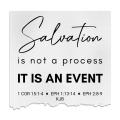
DAY 505: Romans 4:15 says: "Because the law worketh wrath: for where no law is, there is no transgression." How could the Law justify a sinner? Obviously the Law must condemn the sinner. Indeed there ... View MoreDAY 505: Romans 4:15 says: "Because the law worketh wrath: for where no law is, there is no transgression." How could the Law justify a sinner? Obviously the Law must condemn the sinner. Indeed there would be no transgression if there were no law to transgress. Every criminal knows that "the law worketh wrath," and every sinner should know it. The Scriptures abound with testimony to this effect: take your Bible and review the following Scriptures with me: Galatians 3:19; Romans 3:19; Romans 5:20; Romans 7:13; Colossians 2:14; Galatians 3:10; 2 Corinthians 3:9; 2 Corinthians 3:7; 1 Corinthians 15:56.
Yet, with all this testimony from the Word of God, men will continue to seek to gain salvation by the works of the Law, approaching God on their terms--which He will never accept. He will not sell justification at any price, certainly not for a few paltry "good" works, offered by men whose entire lives have been corrupted by sin.
Romans 4:16 goes on to say: "Therefore it is of faith, that it might be by grace; to the end the promise might be sure..." This also the Apostle stresses in his Galatians epistle: "But the Scripture hath concluded all under sin, that the promise by faith of Jesus Christ might be given to them that believe" Gal. 3:22.
All Abraham's seed, both that which is "of the law" and that which is "of the faith of Abraham," will share in the promise made to Abraham, but this has its lesson for us today.
If justification were by the works of the Law, rather than by grace, through faith, how could we be sure of it?
Depend upon the Law; toil to earn justification, and you will never be sure of acceptance with God. But rest in His promise and your security could not be more complete.
What a blessing that God has made salvation accessible through the easiest, simplest, free-est of channels! There is no toil in faith, no effort, and therefore no merit, no boasting--and His Word is a sure foundation to rest upon.
It is in view of the foregoing that Verse 16 calls Abraham "the father of us all," i.e., the father of all who simply take God at His Word.
Stay tuned...
DAY 504: As the Apostle has shown that righteousness is imputed to believers entirely apart from circumcision, he now proceeds to demonstrate that it is imputed entirely apart from the Law. This woul... View MoreDAY 504: As the Apostle has shown that righteousness is imputed to believers entirely apart from circumcision, he now proceeds to demonstrate that it is imputed entirely apart from the Law. This would interest Romans as well as Jews, for among the Romans law was held in such high regard that the echo of the Roman Code, as well as that of the Law of Moses, can be heard in our British and American courts of justice. Romans 4:13-16: "For the promise, that he should be the heir of the world, was not to Abraham, or to his seed, through the law, but through the righteousness of faith. For if they which are of the law be heirs, faith is made void, and the promise made of none effect: because the law worketh wrath: for where no law is, there is no transgression. Therefore it is of faith, that it might be by grace; to the end the promise might be sure to all the seed; not to that only which is of the law, but to that also which is of the faith of Abraham; who is the father of us all."
God does not hold the great men of Scripture up to us because of their moral goodness. Almost invariably their records are spoiled by failure and sin. But God bids us behold their faith and observe how He blessed them for believing Him. We have already seen this from verses 1-5, and it is emphasized with great force in Hebrews 11. Here we find many variables, but one CONSTANT: "BY FAITH...BY FAITH...BY FAITH." Many of the sins and shortcomings of these "heroes of faith" are omitted from Hebrews 11, for God's purpose in this chapter is to show how He honored their faith. This great chapter opens and closes with the declaration that those listed all "obtained a good report through faith" (Vers. 2, 39). It is amazing what God will do for men if they will simply believe Him and trust Christ for salvation.
Verse 13: neither Abraham nor his seed earned the honor of justification, nor was it conferred upon them "through the law." It was simply promised to them. In fact, the Law was not even given until hundreds of years later.
Verse 14: what is the purpose of a promise if it is not to be believed and relied upon? And a legal contract immediately makes any oral promises "of none effect." This should be self-evident, but many still need to learn it. In Galatians 3:18, again referring to Abraham, Paul presses this truth home: "If the inheritance be of the law, it is no more of promise: but God gave it to Abraham by promise." And the lesson is to us is clear from the same passage (read verses 11,12).
Stay tuned...
DAY 503: In Romans 4:1-8 the Apostle uses Abraham and David to demonstrate the validity of his argument for justification by faith, apart from works. Now, from Verse 9 to the end of the chapter he pre... View MoreDAY 503: In Romans 4:1-8 the Apostle uses Abraham and David to demonstrate the validity of his argument for justification by faith, apart from works. Now, from Verse 9 to the end of the chapter he presses this truth home, demonstrating further that righteousness is imputed to believers entirely apart from circumcision and entirely apart from the Law.
The Jew and the Gentile are often called "the Circumcision" and "the Uncircumcision" in Scripture.
" Cometh this blessedness"--the double blessedness of righteousness imputed and sins NOT imputed--"upon the circumcision only, or upon the uncircumcision also"? This was a natural question for the Jew to raise seeing that the Apostle had just said that "faith was reckoned to Abraham for righteousness," and Abraham was the father of the Hebrew race--of which David also was a member.
To answer this question, Paul asks another: "How was (faith) then reckoned (to Abraham)? When he was in circumcision, or in uncircumcision?" And the answer is obvious: "Not in circumcision, but in uncircumcision" (Ver. 10).
Circumcision did not justify Abraham. It was merely a "sign," a token; "a seal of the righteousness of the faith which he had yet being uncircumcised" (Ver. 11). Thus he became "the father of all them that believe, though they be not circumcised" (Ver. 11).
On the same basis he became "the father of circumcision," not to those who merely submitted to the religious rite of circumcision, but "who also walk in the steps of that faith" which Abraham had, "being yet uncircumcised," i.e., he became the father of those Jews who truly believe (Ver. 12). Such have the reality of which circumcision was but the outward sign.
"Know ye therefore that they which are of faith, the same are the children of Abraham" (Gal. 3:7).
Stay tuned...
DAY 502: Let's address a seeming contradiction between Romans 4:3-5 and James 2:24.
In Romans 4:3-5 Paul clearly declares that men are justified by faith alone, WITHOUT WORKS, but James 2:24 states... View MoreDAY 502: Let's address a seeming contradiction between Romans 4:3-5 and James 2:24.
In Romans 4:3-5 Paul clearly declares that men are justified by faith alone, WITHOUT WORKS, but James 2:24 states with equal clarity: "Ye see then how that by works a man is justified and not by faith only."
Are these statements actually contradictory, or only apparently so? Let us see.
We believe that the answer to this seeming contradiction is a dispensational one, and with this in view let us note several background comparisons:
The writer in the first place is Paul; in the second place it is James. Paul addresses Gentiles (Rom. 11:13), while James writes to "the twelve tribes (of Israel) which are scattered abroad" (Jas. 1:1). Paul deals with Abraham before his circumcision; James deals with him after his circumcision (as the father of the Hebrew race). Paul quotes from Genesis 15:6 to prove his point; James cites Genesis 22:1-18. Paul mentions only Abraham's acceptance of the good news concerning his seed (Gen. 15:4-6); James deals with his faith in a severe test (Gen. 22:16-18). These are significant differences.
Faith will most assuredly approach God on His terms at any time, and to seek to gain acceptance with Him in any other way would, of course, be unbelief and self-will. Thus, while works never did or could save as such, they did once save as expressions of faith.
Remember Cain and Abel: Abel was accepted because he approached God in God's way. This is the obedience of faith. Cain was rejected because he did not bring the sacrifice which God had required (Gen. 4:5). When God says, "Build an ark...," what will faith do? Faith will build an ark, of course. And when Noah did this he showed his faith in God and "became an heir of the righteousness which is by faith."
Stay tuned...
page=1&profile_user_id=398917&year=&month=
Load More