
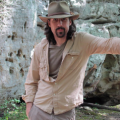
At 4-foot-9 and 97 pounds, every military branch rejected him. So he spent three years writing letters until one finally said yes. Then he became a decorated Green Beret Captain who terrified the enemy in Vietnam.Richard J. Flaherty was born on November 28, 1945, in Stamford, Connecticut. His mother didn't know she had Rh-negative blood, and the complications during birth deprived baby Richard of oxygen. The result was a hormonal imbalance that would stunt his growth permanently. Doctors predicted he'd reach 4'7". He made it to 4'9"—and refused to let those nine inches define his life.Growing up in a military family, Richard dreamed of serving his country. But when he tried to enlist after high school in 1966, reality hit hard. The Army said no. The Navy said no. The Marines, the Air Force—all no. He was too short, too light. The regulations were clear: he didn't meet the physical requirements.Most people would have given up. Richard Flaherty got angry.For three years, he wrote letters. To recruiting offices. To congressmen. To anyone who would listen. He trained relentlessly, building every ounce of muscle his small frame could carry. He studied martial arts. He prepared as if acceptance was inevitable, not impossible.Finally, in 1967, a miracle: a medical waiver. The Army would let him in.But nobody thought he'd survive basic training.His uniforms didn't fit. The equipment was designed for men twice his size. During long marches, he carried a backpack that weighed almost as much as he did. His short legs made it nearly impossible to march in step with his company. The obstacle courses were built for average-sized men—hurdles too high, walls too tall, distances too far.Richard conquered every single one.No rules were changed. No accommodations made. Either he would sink, or he would swim.He didn't just swim—he soared.Richard volunteered for airborne training and became an elite paratrooper with the 101st Airborne Division, the legendary Screaming Eagles. When he jumped from aircraft, instructors had to strap machine gun parts to his body as extra weight so he wouldn't "float away" on descent. His fellow paratroopers started calling him "The Giant Killer"—a nickname that would follow him through history.In 1968, he graduated from Officer Candidate School as a Second Lieutenant. In December of that year, he deployed to Vietnam.Within weeks, Lieutenant Flaherty found himself in hell.The Tet Offensive of January 1968 was one of the bloodiest campaigns of the Vietnam War. Richard led his platoon in the fierce defense of Hue City, where the fighting was brutal and relentless. During one week of combat, he was wounded twice—once by grenade fragmentation, once by a grazing bullet to the head. Each time, medics patched him up. Each time, he jumped right back into the battle.His men learned quickly: their lieutenant's size meant nothing. What mattered was his fearlessness, his tactical brilliance, and his refusal to ask them to do anything he wouldn't do first.After several months on the front lines, many officers gladly accepted rear assignments—safe positions away from the action. Not Richard. He requested transfer to Echo Company to lead a reconnaissance unit conducting dangerous search-and-destroy missions deep into enemy territory. These were the operations with the highest casualty rates, where small teams ventured into places the enemy owned.By the time his first Vietnam tour ended, Richard Flaherty had earned:The Silver Star (for gallantry in action)Two Bronze Stars with ValorTwo Purple HeartsHe was 23 years old.Most war heroes would have been satisfied. Richard was just getting started.He applied for Special Forces training—the Green Berets, the Army's most elite warriors. This meant gaining even more weight and securing another waiver for height requirements. After graduating from the grueling Special Forces Qualification Course, he was assigned to the 3rd Special Forces Group (Airborne) and promoted to Captain.Captain Flaherty deployed to Thailand with the 46th Special Forces Company, where he trained the Royal Thai Army in counterinsurgency operations. Some of their classified missions sent them "across the fence"—covert operations fighting Malaysian and Burmese guerrillas that officially never happened.When he left the military in 1971 due to force reductions, Richard Flaherty had achieved what everyone said was impossible. The boy too small to serve had become one of America's most decorated Special Forces officers.But his story was far from over.What came next reads like spy fiction—except it was real. Richard worked as a military contractor in Rhodesia and for various African governments. He conducted undercover operations for the ATF. Documents later revealed stamps in his passport from Cambodia, Iraq, Jordan, and Venezuela. Friends whispered about CIA connections, clandestine missions, and work in the shadows that would never be declassified.In 1990, Richard Flaherty was homeless in Aventura, Florida. The transition from elite warrior to civilian life had been devastating. He'd been "riffed out" (Reduction in Force) from the Army he loved. A failed relationship and the death of a fiancée had broken something in him. To everyone passing him on the street, he was just another forgotten veteran.But he wasn't forgotten. Not completely.Miami Police Officer David Yuzuk befriended the small homeless man, not knowing his history. For 15 years they talked, and Richard never revealed who he really was. Then one day in 2015, he said, "It's time I tell you who I really am."The stories Richard told seemed impossible. Yuzuk was skeptical—until he started digging. He found the military records, the awards, the decorations. He found storage units filled with classified documents and evidence of missions around the world. Even while homeless, Richard Flaherty had apparently been conducting covert operations.Eight hours after Yuzuk made a call to verify Flaherty's identity, tragedy struck.On May 9, 2015, in the early morning hours, Richard J. Flaherty was killed in a hit-and-run accident. He was 69 years old. The driver, Leslie Socolov, fled the scene but was eventually caught. Despite leaving the scene of a deadly accident, she was never charged with any crime.Richard's death remains shrouded in mystery. What was he working on? Who did he work for? What secrets did he take to his grave?But perhaps the most telling detail of Richard's life was his final wish. Though he qualified for the highest military honors at Arlington National Cemetery—a burial among presidents and generals—he chose something else entirely.He asked to be buried in a small, anonymous cemetery in Milton, West Virginia, next to the woman he loved.The man who spent his life proving he was big enough chose, in the end, to rest in quiet obscurity beside the person who mattered most. No flags, no ceremony, no crowds—just love and memory.Richard J. Flaherty's story has been immortalized in David Yuzuk's award-winning documentary and bestselling book, both titled "The Giant Killer." It's a name that perfectly captures who he was: a man of small stature who cast an enormous shadow.He proved that courage has no height requirement. That determination can overcome any obstacle. That the size of your heart matters infinitely more than the size of your body.Richard Flaherty didn't just break barriers—he obliterated them. And in doing so, he reminded us all that heroes come in every shape and size.Rest in peace, Captain. Your legend lives on
In Album: Judy Gilford's Timeline Photos
Dimension:
799 x 947
File Size:
61.49 Kb


Like (4)
Loading...
Love (1)
Loading...
Wow (1)
Loading...
Michael Blankenship
Bet he could navigate those tunnels like a boss.
1
1
1