THE TWELFTH SUNDAY AFTER TRINITY
August 23, 2026
Pastor Tom Steers
Christ the Saviour Lutheran Church, Toronto
Our Bible Readings:
... View MoreTHE TWELFTH SUNDAY AFTER TRINITY
August 23, 2026
Pastor Tom Steers
Christ the Saviour Lutheran Church, Toronto
Our Bible Readings:
Old Testament – Isaiah 29:17-24
Psalm 146
Epistle – 2 Corinthians 3:4-11
Gospel – Mark 7:31-37
Our Hymn of the Day from Lutheran Service Book is LSB 683, “Jesus Thy Boundless Love to Me” https://www.youtube.com/watch?v=vjIjf3_z_mU&list=RDvjIjf3_z_mU&start_radio=1
The Sermon –
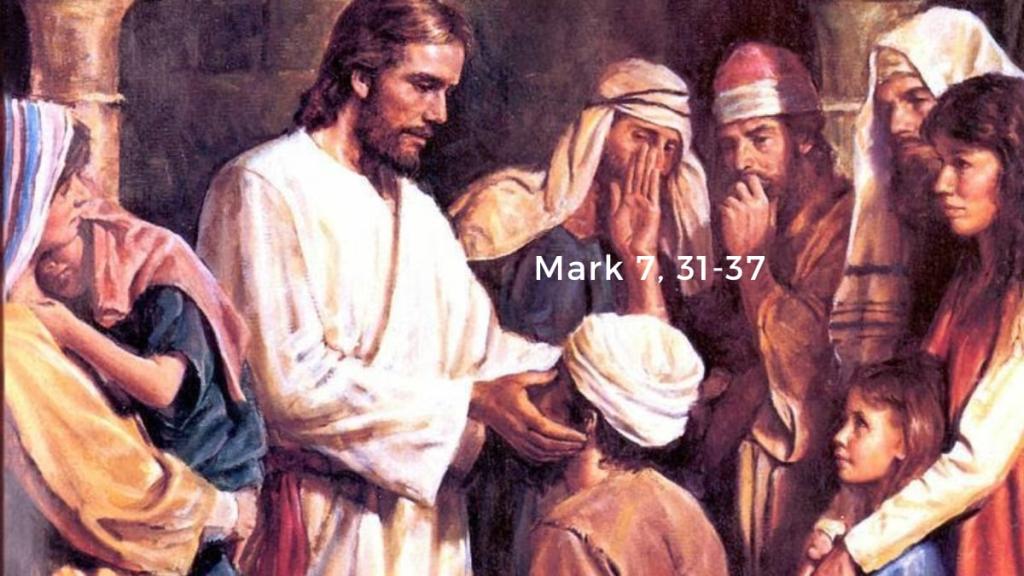
Today’s Gospel tells of a man who couldn’t hear and could hardly speak.
His condition left him isolated from others.
Yet people brought him to Jesus and begged Christ to lay His hand upon him.
Jesus did something remarkable.
He took the man aside from the crowd, put His fingers into the man’s ears, spat, and touched the man’s tongue.
Then Jesus looked up to heaven, sighed, and said to him, “Ephphatha,” which means, “Be opened.”
And immediately the man’s ears were opened, his tongue was released, and he spoke plainly.
The people who witnessed this couldn’t contain their amazement.
They said, “He has done all things well. He even makes the deaf hear and the mute speak.”
Those words are an appropriate confession of faith concerning Christ.
Everything Jesus does is good.
Everything He does is directed toward our salvation.
And yet, sometimes what Jesus does may not, at first, appear good to us.
Sometimes His work seems slow.
At times, His answer to our prayers is not the answer we wanted.
Sometimes He leads us through suffering rather than immediately removing it.
But the Gospel teaches us to trust the One who has done all things well.
Isaiah had proclaimed that a day was coming when God would intervene to save His people.
“The ears of the deaf shall be unstopped,” Isaiah wrote, “and the tongue of the mute sing for joy.”
That promise is being fulfilled before the eyes of the people in Mark’s Gospel.
The signs Jesus performs are not merely demonstrations of supernatural power.
They reveal who Jesus is.
He is the promised Messiah.
He is the One through whom God has come to restore His broken creation.
The problem, however, is much deeper than deaf ears and an impaired tongue.
The physical condition of this man is a picture of the spiritual condition of fallen humanity.
By nature, we are spiritually deaf.
We do not naturally hear and believe the Word of God.
We were not just disabled, but as the Apostle Paul wrote, “you were dead in the trespasses and sins in which you once walked, following the course of this world, following the prince of the power of the air, the spirit that is now at work in the sons of disobedience. . . . ” (Ephesians 2:1-2)
We may hear the sounds of Scripture with our physical ears, but the sinful heart cannot naturally receive God's Word as truth and treasure.
We are also spiritually mute.
We do not naturally confess Christ rightly.
We’re often remarkably capable of speaking about ourselves, our opinions, accomplishments, complaints, and desires.
But when it comes to confessing Christ, our tongues can become strangely silent.
And so, this miracle in Mark Chapter 7 directs us toward something greater than the restoration of one man's hearing and speech.
It points us toward the work of Christ in restoring sinners to God.
This is why the words of Jesus are so important: “Ephphatha”—“Be opened.”
Jesus doesn’t merely provide advice to the deaf man.
He doesn’t tell him to try harder.
He does not ask him to demonstrate sufficient faith before Jesus will act.
Christ speaks, and His Word accomplishes what He commands.
That is how Christ continues to work among us.
As Biblical Lutherans, we take the power and efficacy of God's Word seriously.
God's Word is not merely information about the Almighty.
It is God's living and effective instrument through which He gives His gifts.
This is precisely what Paul teaches in today’s Epistle reading.
“Our sufficiency is from God, who has made us competent to be ministers of a new covenant.”
The new covenant is not based on our ability to keep God's Law.
It isn’t based upon our spiritual strength.
It is not based upon our goodness.
It is based upon Christ.
The Law exposes our sin and shows us our inability to make ourselves righteous before God.
But the Gospel gives what the Law cannot.
The Gospel gives Christ, and through Him forgiveness.
The Gospel gives life.
And the Gospel creates faith.
Therefore, when Christ speaks His Word to us, He isn’t merely telling us something.
He is giving us something.
He gives us His forgiveness, His righteousness, and a new life that leads to life eternal.
He opens ears that are closed to His truth. He loosens tongues that are hesitant to confess His name.
This is why Psalm 146 calls us to praise the Lord who “opens the eyes of the blind,” who “lifts up those who are bowed down,” and who “watches over the sojourners.”
Our salvation doesn’t begin with our reaching out to God.
It begins with God reaching down to us.
It does not begin with our ‘decision’ for Christ.
It begins with Christ's gracious decision to seek and save sinners.
It does not rest upon the strength of our faith.
It rests upon the object of our faith — Jesus Christ.
There is also something wonderfully personal about the way Jesus heals this man.
Jesus takes him aside from the crowd and deals with him individually.
Jesus knows the man's particular need.
He knows his suffering, His isolation.
Jesus acts with compassion.
This reminds us that Christ is not distant from those who suffer.
He is not indifferent to the burdens we carry.
The Lord knows every sorrow, every fear, weakness, and prayer that remains unspoken.
And He deals with His people according to His wisdom and mercy.
Sometimes He grants healing in this life.
Sometimes He permits suffering to remain for a time.
But the Christian knows that Christ’s love and grace remain the same.
He remains the Saviour who has done all things well.
The greatest evidence of this is found not in the miracles of Mark 7, but at the cross.
There Jesus appears to do nothing well according to the world's judgment.
He is rejected, mocked, and beaten.
He is crucified.
His disciples flee.
And yet, precisely there, Jesus is doing all things well.
At the cross, the Son of God bears the sins of the world.
There He suffers in the place of sinners and satisfies divine justice.
There He reconciles us to the Father, and wins forgiveness for you and me.
Three days later, the Father raises Him from the dead.
The resurrection declares that Christ's saving work is complete.
“He has done all things well.”
That is the confession of the Christian Church.
It is also our confession when life is difficult.
When we cannot understand what God is doing, we cling to what God has already done.
Christ has died.
Christ is risen.
Christ has forgiven us.
He has claimed us as His own.
He has promised to raise us from the dead.
And Christ will keep that promise.
Therefore, brothers and sisters, listen to His Word.
Hear once more the Gospel of forgiveness, the absolution, the promises of Holy Scripture.
Hear the words of Christ concerning His Body and Blood given and shed for you for the forgiveness of sins and placed into your mouth in the Lord’s Supper.
And having heard these things, confess.
Confess Christ before the world.
Not because we are strong, but because He has opened our ears.
Not because we are eloquent, but because He has loosened our tongues.
Not because we have made ourselves worthy, but because He has made us His own.
The day will come when every promise of God will be fulfilled completely.
The deaf will hear.
The mute will speak.
The blind will see.
The dead will rise.
And God's redeemed people will stand before Him in everlasting righteousness, innocence, and blessedness.
Then in Heaven we will see with perfect clarity what faith already confesses today: “He has done all things well.”
THE TWELFTH SUNDAY AFTER PENTECOST
August 16, 2026
Pastor Tom Steers
Christ the Saviour Lutheran Church, Toronto
Our Bible Readings:
... View MoreTHE TWELFTH SUNDAY AFTER PENTECOST
August 16, 2026
Pastor Tom Steers
Christ the Saviour Lutheran Church, Toronto
Our Bible Readings:
Old Testament – Isaiah 56:1
Psalm 67
Epistle – Romans 11: 1-2a. 13-15, 28-32
Gospel – Matthew 15:21-28
Our Hymn of the Day from Lutheran Service Book is LSB 615, “When in the Hour of Deepest Need” https://www.youtube.com/watch?v=EavXeYxdCdU&list=RDEavXeYxdCdU&start_radio=1
The Sermon –
A Canaanite woman with a possessed daughter approaches Christ with an appeal.
At first glance, Jesus seems harsh toward her.
She cries out, “Have mercy on me, O Lord, Son of David; my daughter is severely oppressed by a demon.”
Yet Jesus does not immediately answer.
When she continues to plead, the disciples want her sent away.
When Jesus finally speaks, He says, “I was sent only to the lost sheep of the house of Israel.”
Still, she comes and kneels before Him, saying, “Lord, help me.”
Jesus answers, “It is not right to take the children’s bread and throw it to the dogs.”
Those are difficult words.
But if we understand what the Canaanites represented in Israel's history, we begin to understand why Jesus speaks as He does.
The Canaanites were not simply another ethnic group living nearby.
They were one of the pagan nations who had rejected the true God and persecuted the Jewish people
They did not have the Old Testament promises concerning the coming Messiah.
They didn’t worship the Lord or follow His revealed Law.
Their religious practices included idolatry and occult rituals. And among the Canaanites there was the horrifying practice of child sacrifice.
This is the background behind the apparent harshness of Jesus’ response.
He is not being cruel.
He is exposing the distinction between the children of the covenant and those who rejected it.
And yet, there is something extraordinary happening here.
This woman, a Canaanite, comes to Jesus confessing what many within Israel themselves failed to believe.
She calls Him “Lord” and “Son of David.”
She recognizes Him as the promised King.
And she believes that He has authority over the demonic powers that have enslaved her daughter.
Where did this faith come from?
She had heard about Jesus.
The preceding chapters of Matthew tell us that Jesus had been teaching, preaching, healing the sick, casting out demons, and proclaiming the Kingdom of God.
It is entirely reasonable to suppose that this woman had listened to Christ preach.
The Word had done its work.
The Holy Spirit brought her to faith.
She had at least heard about Jesus, and now clung to Him.
That is the heart of today’s Gospel.
Faith does not trust in itself.
Faith doesn’t say, “I am worthy.”
Nor does it demand that “God owes me this.”
Faith clings to Christ and His mercy.
Notice what happens when Jesus appears to reject her.
She doesn’t leave or become offended.
She doesn’t say, “If You will not help me, I’ll find another god.”
Instead, she humbly persists.
“Lord, help me.”
Jesus presses her faith even further: “It is not right to take the children’s bread and throw it to the dogs.”
And she answers, “Yes, Lord, yet even the dogs eat the crumbs that fall from their masters’ table.”
What a confession of faith!
She does not argue that she deserves the children’s bread.
She won’t claim righteousness based upon her ancestry, morality, or her religious accomplishments.
She admits her unworthiness.
But she knows something about Christ.
She knows that there is more than enough mercy in Him.
That even a crumb of His grace is sufficient.
She believes that Jesus can help her.
And Jesus responds, “O woman, great is your faith! Be it done for you as you desire.”
Then Matthew tells us, “And her daughter was healed instantly.”
The woman came asking for mercy, and Christ gave it.
She came confessing her unworthiness, and Christ gave her what she needed.
The woman appealed to Jesus because she trusted His Word, and Jesus proved His Word is trustworthy.
This is important, because there is a temptation for some to read this account as merely an example of human perseverance.
We might say, “Persist like the Canaanite woman.”
But the Gospel is not about the greatness of the woman’s determination.
It is about the greatness of Christ.
Her faith is great because its object is.
Her faith clings to the One who has authority over demons, disease, sin, death, and the devil.
Her faith has nothing in itself upon which to boast.
It rests entirely upon Jesus.
And this is where the other readings appointed for today help us.
Isaiah speaks of the day when those who were once outside the covenant would be gathered to the Lord.
God declares, “My house shall be called a house of prayer for all peoples.”
The Canaanite woman gives us a glimpse of that promise being fulfilled.
The Gospel is going beyond the boundaries of Israel.
The Messiah who first came to the lost sheep of Israel is the Saviour of the nations.
Psalm 67 looks forward to the world rejoicing in God’s salvation.
“Let the peoples praise you, O God; let all the peoples praise you!”
The Apostle Paul makes the same point in Romans.
God has not forgotten His promises to Israel.
Yet His mercy extends to both Jew and Gentile alike, so that they may stand before Him dependent upon the same grace.
Paul says that God has consigned all to disobedience, that He may have mercy on all.
That is the great mystery of the Gospel.
None of us comes before God having earned or deserved salvation.
We come as sinners.
As people who have fallen short of God's Law.
We come as a fallen humanity who cannot free ourselves from sin, death, and the devil.
Yet we share something else with the Canaanite woman.
We have the Word of Christ.
And that Word creates faith.
We hear God’s Word proclaimed in the preaching of the Gospel.
We hear that Christ Jesus, the Son of David, has died for sinners.
We hear that He has risen from the dead, and that our sins are forgiven for His sake.
Through that Word, the Holy Spirit brings us to trust in Christ.
Within the Church, Christ also gives us His grace through His Sacraments.
In Holy Baptism, He joins us to His death and resurrection.
In Absolution, He speaks forgiveness into our ears.
In the Lord’s Supper, Jesus gives us His true body and blood for the forgiveness of sins.
Through these means of grace, Christ continues to rescue His people from bondage.
The Canaanite woman’s daughter was freed from demonic oppression.
We too have been rescued from death and evil.
Christ has freed us from the condemnation of sin.
He has conquered death for us.
He has defeated the devil.
And He gives us a new life that leads to life eternal.
When you feel unworthy, do not despair, nor turn away from Christ.
Remember His promise.
When our conscience accuses us, we should cling to His grace.
When suffering causes us to cry out, “Lord, help me,” we can take comfort.
The One we appeal to has proven His love for us upon the cross.
And through His wounds we are healed.
The Canaanite woman teaches us what saving faith looks like.
It looks away from itself and toward Christ.
It doesn’t trust in its own worthiness.
It trusts in His mercy.
Faith receives His Word and clings to His promise.
And in Christ, we receive not merely crumbs.
We receive the Bread of Life Himself.
Your sins are forgiven.
You belong to Jesus. You are His.
And no power of sin, death, or the devil can finally overcome the One who has redeemed you.
For His mercy is greater than our unworthiness, His grace is greater than our sin, and His promise of salvation is sure.
THE ELEVENTH SUNDAY AFTER PENTECOST
August 9, 2026
Pastor Tom Steers
Christ the Saviour Lutheran Church, Toronto
Our Bible Readings:
... View MoreTHE ELEVENTH SUNDAY AFTER PENTECOST
August 9, 2026
Pastor Tom Steers
Christ the Saviour Lutheran Church, Toronto
Our Bible Readings:
Old Testament: Job 38:4-18
Psalm 18:1-16
Epistle: Romans 10:5-17
Gospel: Matthew 14:22-33
The Sermon –
“Take Heart; It Is I. Do Not Be Afraid.”
Jesus sends His disciples across the Sea of Galilee while He goes up on a mountain to pray.
Today’s Gospel events occur after the Feeding of the Five Thousand.
As the twelve make their way across the water, the wind turns against them, and waves batter the boat.
They’re far from shore, and Jesus is not with them.
Then, in the fourth watch of the night, sometime between 3 and 6 a.m., Jesus comes to them, walking on the sea.
The disciples see Him; and they’re terrified.
They think they’ve encountered a ghost.
But Jesus speaks immediately: “Take heart; it is I. Do not be afraid.”
Those words are at the heart of this Gospel.
The disciples are afraid because they’re in circumstances that seem beyond their control.
The wind and waves are threatening.
Darkness surrounds them.
And Jesus, they thought, was far away.
Yet Christ has not abandoned them.
He comes to them in the midst of their distress.
There is a central Christian truth here.
Faith does not mean the storms of life disappear.
Faith doesn’t guarantee Christians will never experience fear, suffering, or uncertainty.
Faith means that in the midst of all these things, we have Jesus and His Word.
And Christ's Word is sufficient.
The Old Testament reading from Job reminds us of the greatness and majesty of God.
The Lord asks Job, “Where were you when I laid the foundation of the earth?”
Who established the boundaries of the sea?
Who commanded the morning?
Who has seen the gates of death?
The questions are meant to humble Job before his Lord.
God is not merely one who possesses some power.
He is the Creator of heaven and earth.
The sea itself is under His authority.
And that’s precisely what we see in the Gospel.
Christ calms the storm.
He walks upon the very waters that panic the disciples.
The One who comes to them is the Lord of all creation.
The God who laid the foundations of the earth has come among His people in human flesh.
This is one of the great mysteries and comforts of Christianity.
Jesus is true man, and also true God.
And He comes to His frightened followers with a Word of comfort: “Take heart; it is I. Do not be afraid.”
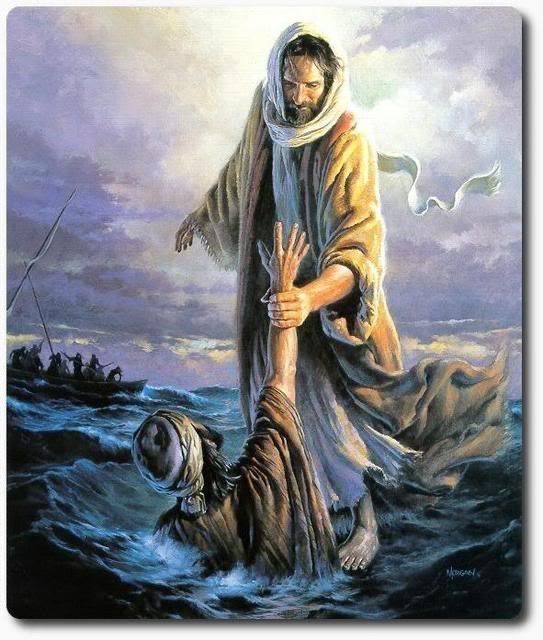
Peter responds, “Lord, if it is you, command me to come to you on the water.”
Jesus says, “Come.”
Peter gets out of the boat and walks upon the water toward Christ.
But then the disciple sees the wind and waves.
He fears and begins to sink.
Peter cries out, “Lord, save me!”
And immediately Jesus reaches out His hand and takes hold of him.
Notice the simplicity of Peter's plea.
There is no elaborate theological argument here.
No attempt to save himself.
It is the simple plea of a sinner who knows he cannot save himself.
And Jesus saves him.
This is pure Gospel.
The Christian faith is not about the power of our belief.
It is about the strength of the One in whom faith rests.
Peter's faith is weak.
He becomes afraid, takes his eyes off Jesus, and begins to sink.
But Jesus remains all-powerful.
And when the disciple cries out, it is Christ who reaches down and saves him.
This is a beautiful portrait of the Christian life.
There are times when our faith is strong.
And times when we’re frightened, discouraged, and uncertain.
There are times when we focus on the storm, rather than Christ.
There are moments when we wonder whether the Lord is really with us.
But our salvation doesn’t depend upon the perfection of our faith.
Our redemption rests upon the faithfulness of Christ.
That’s why Romans Chapter 10 is so important for understanding the Gospel.
St. Paul writes, “Everyone who calls on the name of the Lord will be saved.”
Then he asks, “How are they to call on him in whom they have not believed?”
Paul goes on to inquire how they are to believe without hearing.
Finally, he declares, “So faith comes from hearing, and hearing through the word of Christ.”
Faith comes through hearing the Word of our Saviour.
That is the Lutheran confession.
We do not manufacture faith within ourselves.
We don’t climb our way up to Heaven through personal spiritual efforts.
God came down to us.
He speaks His Word.
And through that Word, the Holy Spirit creates and sustains faith.
Peter wasn’t saved because he successfully walked across the water.
He was saved because Jesus reached out His hand.
We are not saved because we’ve lived a sufficiently faithful, perfect Christian life.
We’re saved because Christ lived the perfect, sinless life we cannot, and then paid for our sins at Calvary.
He rose from the dead, ascended into heaven, and reaches out His hands to us today through His Church, through His Word and Sacraments.
He has reached out through His Gospel.
Through Holy Baptism.
Through Absolution.
And He gives us His true body and blood in the Lord’s Supper.
Today, Christ speaks His saving Word to human beings who cannot save themselves.
“Take heart; it is I. Do not be afraid.”
There is another important detail in this Gospel passage.
Jesus doesn’t merely tell Peter to stop being afraid.
He asks, “O you of little faith, why did you doubt?”
The answer is not that Peter needed to be a stronger person.
Peter needed to trust the Word of Jesus.
That’s also our need.
We live in a world filled with storms.
Storms within families, in society, and within our hearts.
There are moments when the future seems uncertain, and the Lord distant.
But Christians do not live by what we see.
Believers live by the Word of Christ.
The world says, “Look at the storm.”
Jesus says, “Look to Me.”
The world says, “Save yourself.”
Christ says, “Take heart; it is I.”
The world warns, “You must be strong to live.”
Christ says, “I am the way, and the truth, and the life.”
Psalm 18 gives us words that fit beautifully with Peter's cry.
“The cords of death encompassed me; the torrents of destruction assailed me.”
Yet the psalmist declares, “I love you, O LORD, my strength.” “The Lord is my rock and my fortress and my deliverer, my God, my rock, in whom I take refuge.”
The same Lord who delivered the psalmist is the One who comes walking on the sea.
He is our Lord today.
At the end of the Gospel, the disciples worship Jesus.
And they confess what Peter had begun to understand: “Truly you are the Son of God.”
That is where the Gospel leads us – to Christ.
It does not tell us to admire Peter's faith.
It calls us to behold Christ's faithfulness.
It doesn’t tell us that Christians will never sink; it reassures that when we do, Christ is there to rescue and redeem.
The hands that reached down to Peter would one day be stretched out upon the cross.
There, Jesus would bear the sins of the world.
There, the Lord of all creation would fully accomplish the salvation we could not, in whole or part.
And because Christ has died and risen again, we can trust His Word.
When our conscience accuses, Christ says, “You are forgiven.”
When we’re burdened by sin, Jesus reassures, “Take heart.”
When suffering overwhelms us, Christ says, “It is I.”
When death approaches, Christ comforts and says, “Do not be afraid.”
When we cry, “Lord, save me,” He does.
Dear Christians, do not put your confidence in the strength of your faith.
Put your trust in Christ.
Do not look at the size of the storm.
Look to the One who walks on the waters.
Don’t rely on your ability to rescue yourself.
When your faith is weak, and you feel abandoned, remember your Saviour has promised, “I will not leave you as orphans; I will come to you.”
Trust in the One who saves, now and for eternity.
Amen.
Hymn of the Day: Lutheran Service Book 717, “Eternal Father, Strong to Save”
https://www.youtube.com/watch?v=7VrraIIjabo&list=RD7VrraIIjabo&start_radio=1
THE TENTH SUNDAY AFTER PENTECOST
August 2, 2026
Pastor Tom Steers
Christ the Saviour Lutheran Church, Toronto
-- A Confessional Lutheran Church
... View MoreTHE TENTH SUNDAY AFTER PENTECOST
August 2, 2026
Pastor Tom Steers
Christ the Saviour Lutheran Church, Toronto
-- A Confessional Lutheran Church
Our Bible Readings –
Old Testament: Isaiah 55:1-5
Psalm 136:1-9
Epistle: Romans 9:1-5
Gospel: Matthew 14:13-21
Our Hymn for the Day from Lutheran Service Book is LSB 642, “O Living Bread from Heaven”
The Sermon –
“Give Us This Day Our Daily Bread”
Grace, mercy, and peace to you from God our Father and our Lord and Saviour Jesus Christ. Amen.
There are few things more unsettling than realizing you don’t have enough.
Not enough money to pay the bills.
Not enough strength to carry another burden.
Not enough wisdom to solve a life crisis.
Not enough hope to face tomorrow.
The disciples knew exactly what that was like.
Standing before them was an enormous crowd — five thousand men, besides women and children.
Evening was approaching.
There was no nearby village large enough to feed them. They counted what little they had: five loaves of bread and two fish.
It wasn’t enough.
Their conclusion seemed reasonable.
"Send the crowds away."
It was the practical response. Let the people fend for themselves.
But the earthly solution was not the Lord's solution.
Jesus replies, "They need not go away; you give them something to eat."
The disciples must have looked at one another in disbelief.
How could they possibly feed this multitude?
They were being confronted with something far beyond every human ability.
And that’s precisely where Jesus wanted them to be.
For throughout Holy Scripture, the Lord delights in showing that His grace begins where human resources end.
Isaiah proclaims this very truth in today's Old Testament lesson.
"Come, everyone who thirsts, come to the waters; and he who has no money, come, buy and eat."
Notice who receives the invitation.
Not the wealthy.
Not the proud.
Not to those who feel they have earned God's favour.
The invitation is extended to those who have nothing.
The spiritually poor.
The drink and the food are the Word of God.
The Word spoken in the Old Testament as promise.
The Word fulfilled in the New Testament, God in Human flesh.
The gift of grace is for those who realize they cannot buy salvation.
It is for human beings incapable of paying for their sins.
It’s for those who thirst for righteousness.
That is the Gospel.
The Lord gives freely what sinners could never purchase.
Forgiveness and eternal life.
Heaven cannot be earned.
Salvation is not a reward for the deserving, but a gift given to the undeserving.
Everything depends upon God's grace.
Our good works are like filthy rags. (Isaiah 64:6)
Only the good work Christ did on the altar of the cross could pay for the sins of the world.
The disciples are slowly learning that lesson in the wilderness.
Their hands are empty.
But Christ's hands are full.
Matthew tells us that Jesus had withdrawn after hearing of the death of John the Baptist.
John had faithfully proclaimed God's Word and paid for it with his life.
Jesus was grieving.
He desired solitude.
Yet when He saw the crowds, Matthew writes, "He had compassion on them and healed their sick."
That word "compassion" tells us everything about our Lord.
His heart is moved toward those who suffer.
He doesn’t turn away.
He does not tell them they’re an inconvenience.
Instead, He gives.
He heals and feeds.
This is the heart of God incarnate revealed.
Throughout the Gospels, whenever Jesus encounters human misery, His compassion is never merely emotional.
It acts.
It restores, forgives, heals, saves.
That same compassion ultimately carries Him to Calvary.
There He sees an entire world starving — not for bread — but for forgiveness.
Humanity has nothing to offer God except sin.
We possess no spiritual riches.
No righteousness of our own.
No merit worthy of heaven.
Like the crowd in the wilderness, we stand empty-handed.
Yet Christ gives Himself.
He becomes the Bread of Life broken for the life of the world.
His body is given; His blood is shed; mercy is freely bestowed.
His redemption is a gift to believers.
It is unmerited favour for sinners who receive faith worked within them by the Holy Spirit through God’s means of grace.
Isaiah's invitation is fulfilled in Christ.
"Come . . . without money and without price."
Notice the disciples' response.
They see only limitations.
Five loaves.
Two fish.
Impossible numbers.
How often we do the same.
We look at declining church attendance.
We see aging congregations.
Limited budgets.
Few volunteers.
A culture increasingly indifferent — even hostile — to Christianity.
And we begin to think like the disciples.
"There isn't enough."
But Christ has never depended upon human abundance.
He has always worked through weakness.
The Church has never been sustained by impressive resources.
She has been sustained by the Word of Christ.
The Gospel has never depended upon human strength.
It is the power of God for salvation, and His gracious will.
Saint Paul reminds us of this in Romans Chapter 9.
Paul grieves deeply over many of his fellow Israelites who have rejected Christ.
Yet he immediately adds that God's Word has not failed.
The Lord's saving purposes never depend upon human effort or ancestry.
They rest entirely upon His gracious promise.
Election, rightly understood, does not produce anxiety.
It offers hope.
Our salvation doesn’t depend upon our strength, but on God's faithfulness in Christ.
It is a gift, yet one that can be rejected with dire consequences.
The disciples' success wasn’t founded on their ability to provide food.
It depended upon Jesus.
Everything depends upon Christ.
Matthew describes the miracle with remarkable simplicity.
Jesus takes the loaves.
He looks up to heaven.
He blesses them, breaks them, gives them to the disciples.
And the disciples give them to the crowds.
There is a beautiful pattern here.
Christ gives.
His servants distribute.
This continues throughout the Church today.
Pastors do not invent forgiveness.
They distribute what Christ has entrusted to them.
They do not create the Gospel.
They proclaim it.
They do not manufacture the Sacraments.
They administer what Christ Himself instituted.
The ministry has always been one of faithful distribution.
Christ remains the Giver.
This miracle also points us toward the Lord’s Supper.
The actions are familiar.
He takes, blesses, breaks, and gives.
Soon, in the Upper Room, He will do the same with bread and wine, giving His true body and blood for the forgiveness of sins.
The feeding of the five thousand is not the Holy Supper itself, but it points forward and prepares our eyes to recognize the generous heart of the One who feeds His people.
Here our Lord satisfies physical hunger.
At the communion rail He satisfies the deepest hunger of all — the hunger for forgiveness, reconciliation, and eternal life.
Notice the result.
"All ate and were satisfied."
Not almost everyone. Not most.
All.
There was no shortage.
No one left hungry.
Then came an astonishing detail.
Twelve baskets remained.
The disciples would be left with the saving message of Christ.
With God’s Word and Sacraments to distribute to the nations after the Ascension.
After the descent of the Holy Spirit upon them at Pentecost.
Our Lord never gives sparingly.
Psalm 136 repeatedly declares, "For His steadfast love endures forever."
Again, and again, the refrain reminds us that God's mercy is always greater than our sins.
His compassion is not exhausted.
His forgiveness and grace aren’t rationed.
Every Sunday Christians gather because we know exactly where Christ has promised to feed His people.
He feeds us through His Holy Word.
He brings us to new life through Holy Baptism, where He claims us as His own.
He forgives and sustains us at His Holy Table with His own body and blood.
The world offers countless substitutes.
Wealth, pleasure, power.
Yet every worldly promise eventually leaves the soul hungry again.
Only Christ satisfies completely.
Only Jesus gives food that endures to eternal life.
Dear brothers and sisters, every one of us comes into the Church carrying empty baskets.
Some carry sorrow.
Others shame.
Some harbor fear.
Others loneliness.
Some carry burdens that no one else knows.
Christ sees every one of them.
And just as He looked upon that great crowd with compassion, so He looks upon you today.
He doesn’t send you away.
Instead, He invites you to Himself.
He speaks His absolution.
He feeds you with His Gospel.
He strengthens your faith.
He assures you that His steadfast love endures forever.
He invites you to pray to our Heavenly Father for His loving provision and protection in the Lord’s Prayer.
“Give us this day our daily bread.”
All that we need in this life, the physical and the spiritual.
One day, the miracle of the feeding of the five thousand will reach a final fulfillment.
The Book of Revelation speaks of the marriage feast of the Lamb in His kingdom, where God's redeemed people will hunger and thirst no more.
There, Christ Himself will welcome believers to the eternal banquet.
Until that glorious day, we live through His gifts, trust His promises, and receive His mercy.
And we rejoice that our compassionate Saviour never runs out of grace.
For the One who fed the multitude still feeds His Church today.
And all who come to Him will be satisfied.
In the name of the Father and of the Son and of the Holy Spirit. Amen.
THE NINTH SUNDAY AFTER PENTECOST
July 26, 2026
Pastor Tom Steers
Christ the Saviour Lutheran Church, Toronto
Our Bible Readings –
... View MoreTHE NINTH SUNDAY AFTER PENTECOST
July 26, 2026
Pastor Tom Steers
Christ the Saviour Lutheran Church, Toronto
Our Bible Readings –
Old Testament: Deuteronomy 7:6-10
Psalm 125
Epistle: Romans 8:28-39
Gospel: Matthew 13:44-52
The Hymn of the Day: Lutheran Service Book 713, “From God Can Nothing Move Me”
https://www.youtube.com/watch?v=IGNZ3UgOtHk&list=RDIGNZ3UgOtHk&start_radio=1
Sermon –
"The Treasure Christ Purchased"
Grace, mercy, and peace to you from God our Father and our Lord and Saviour Jesus Christ. Amen.
When people read these little parables of Jesus in Matthew 13, they often see them as a challenge.
"The kingdom of heaven is like treasure hidden in a field."
"The kingdom of heaven is like a merchant searching for fine pearls."
Then come the conclusions many people draw:
"If you want the kingdom of heaven, you must sell everything.”
“You must give up enough, surrender enough.”
“You must work to make Christ the greatest treasure in your life."
At first, that sounds very pious.
Yet there is one serious problem.
If that’s what Jesus is teaching, then salvation becomes something that depends upon you.
How much have you surrendered?
Have you truly given everything?
Have you loved Christ and sacrificed enough?
Suddenly these beautiful little parables become crushing demands of the Law rather than joyful proclamations of the Gospel.
And that is not what Jesus intends.
For throughout Scripture we learn that sinners cannot purchase God's Kingdom.
God purchases sinners.
The Bible never suggests that we buy salvation.
It repeatedly states that Christ bought us.
St. Paul tells the Corinthians,
"You were bought with a price."
St. Peter speaks of "the Master who bought them."
Our Small Catechism confesses that Jesus Christ has "redeemed me, a lost and condemned person... not with gold or silver, but with His holy, precious blood and with His innocent suffering and death."
That language should immediately make us look again at these parables.
Who is the One who purchases?
And what is being purchased?
Jesus says that a man discovers treasure hidden in a field.
Filled with joy, he sells everything he has and buys the field.
Notice where all the action is.
The treasure does nothing.
It is hidden.
Buried.
Passive.
Someone else acts.
Someone else pays the price.
Earlier in this very chapter, Jesus explained one of His parables by saying, "The field is the world."
The field has already been defined.
So, who is the One who purchases the world?
Certainly not us.
None of us possesses enough righteousness to purchase God's favour.
The Prophet Isaiah explains that even our righteous deeds are like filthy rags before God.
Romans tells us that we were helpless under sin.
We have nothing to offer.
Nothing to buy with.
Nothing worthy of God.
The Law exposes our complete spiritual bankruptcy.
We cannot purchase heaven.
We can’t buy forgiveness.
We won’t purchase eternal life.
But there is One who can.
There is One who joyfully gave everything He possessed.
There is One who laid aside the glory of heaven.
One who humbled Himself unto death — even death on a cross.
Our Lord Jesus Christ.
He entered this fallen world.
He came looking for what was precious to Him.
Not because we were shining like polished gold.
Not because we were already beautiful pearls.
We were hidden beneath the dirt of sin.
Covered by guilt.
Dead in trespasses.
Yet Christ saw what His Father had chosen from before the foundation of the world.
The hidden treasure.
His Church.
His redeemed people.
You.
Out of immeasurable joy He sold everything.
Not literally by visiting a marketplace.
But by emptying Himself.
By giving His perfect life.
By shedding His holy and precious blood.
By enduring God's righteous judgment against sin.
He purchased the field — the world — with the price of His innocent, holy blood, so that His treasured possession would belong to Him forever.
This is pure Gospel.
Notice how different that is from saying, "You must treasure Christ enough."
Instead, Christ treasures you.
That changes everything.
For now, your salvation rests, not upon the strength of your surrender, but upon the completeness of His redemption.
That fits beautifully with our Old Testament lesson.
Moses tells Israel,
"The LORD your God has chosen you to be a people for His treasured possession."
Why?
Because Israel was greater than the other nations?
Holier?
More deserving?
No.
Moses explained that in Deuteronomy 9:6, “Know, therefore, that the Lord your God is not giving you this good land to possess because of your righteousness, for you are a stubborn people.”
And that could be said of all of us, for all have sinned and fall short of the glory of God.
Fortunately, the LORD set His love on us.
Everything begins with God's gracious choice, His steadfast love, His faithfulness.
That same truth continues in our Epistle.
"We know that for those who love God all things work together for good, for those who are called according to His purpose."
Notice once again where the emphasis falls.
Not on human achievement.
But on God's calling.
God's purpose, His eternal plan.
Those whom He foreknew He also predestined to be conformed to the image of His Son.
Before you ever sought Him, He sought you.
Before you ever loved Him, He loved you.
Before you could ever reach for Him, He redeemed you.
That’s exactly what these little parables proclaim.
The second parable says much the same thing.
A merchant searches for beautiful pearls.
Finding one pearl of great value, he sells everything and buys it.
Again, all the action belongs to the merchant.
The pearl contributes nothing to its own purchase.
It simply holds great value in the eyes of the buyer.
That is how Christ looks upon His redeemed Church.
You may not see much value in yourself.
The devil constantly reminds us of our failures.
Our consciences accuse us daily.
So, we see weakness.
We see sin.
Yet, Christ sees someone worth redeeming.
Not because of our goodness.
But because of His love.
His cross determines your worth.
The price He paid tells you how precious you are to Him.
The cross forever answers the question, "Am I valuable to God?"
You are worth the blood of His own Son.
That is not sentiment.
It’s the objective reality of redemption.
Finally, Jesus tells the brief parable of the fishing net.
The Gospel goes out into the world like a great net.
People are gathered into the visible Church.
At the end of the age there will be a separation.
The angels will separate the evil from the righteous.
That sounds frightening.
And it should.
For apart from Christ none of us could stand in the judgment.
Yet those who belong to Christ need not fear.
The One who purchased the treasure will not lose it.
The One who bought the pearl will not abandon it.
The One who redeemed you with His blood will bring His work to completion.
As the Psalm appointed for today explains, "Those who trust in the LORD are like Mount Zion, which cannot be moved."
Why?
Because the Lord surrounds His people, Christian believers.
Your security rests not in the firmness of your grip upon Christ, but in His everlasting grip upon you.
Dear friends, these little parables are not about the price you must pay.
They’re about the price Christ has already paid.
They are not a call to earn redemption.
They are a proclamation that salvation has already been purchased.
We were hidden beneath the dirt of sin.
Christ found us.
We were spiritually bankrupt.
Christ paid the debt.
We were lost.
Christ redeemed us.
We were dead.
Christ gave us life.
And now you belong to Him — not because of your sacrifice, but because of His.
That is why we come again today to His altar.
There the Heavenly Merchant continues to distribute the benefits of the purchase He made at Calvary.
There He places into your mouth and into your hands the body that was given for you and the blood that purchased your redemption.
There He assures us once again,
"You are Mine."
And because you are His treasured possession, nothing — not death, not Satan, not your own weakness — can separate you from the love of God that is in Christ Jesus our Lord.
In the name of the Father and of the Son and of the Holy Spirit. Amen.
THE EIGHTH SUNDAY AFTER PENTECOST
July 19, 2026
Pastor Tom Steers
Christ the Saviour Lutheran Church, Toronto
Our Bible Readings:
... View MoreTHE EIGHTH SUNDAY AFTER PENTECOST
July 19, 2026
Pastor Tom Steers
Christ the Saviour Lutheran Church, Toronto
Our Bible Readings:
Old Testament – Isaiah 4:6-11
Psalm 119:57-64
Epistle – Romans 8:18-27
Gospel – Matthew 13:24-30, 36-43
The Hymn of the Day from Lutheran Service Book is LSB 659, “Lord of Our Life” https://www.youtube.com/watch?v=xhcXR5HY4Lc&list=RDxhcXR5HY4Lc&start_radio=1
THE SERMON –
"The Wheat and the Weeds"
Grace, mercy, and peace to you from God our Father, and our Lord and Saviour Jesus Christ. Amen.
There are times when we wish God would act immediately.
When we see evil flourish, when falsehood is celebrated, when wickedness appears to prosper while righteousness suffers, we naturally ask, "Lord, why do You allow this to continue?"
We long for justice. We want God to remove evil from the world now.
Jesus addresses exactly this question in today's Gospel through the Parable of the Wheat and the Tares.
A farmer sowed good seed in his field.
The seed was pure, healthy wheat.
Yet while everyone slept, an enemy came under cover of darkness and sowed weeds among the wheat before slipping away unnoticed.
As the plants grew, so did the weeds.
The servants were alarmed. They asked the master, "Do you want us to go and gather them?"
The master's answer surprises us.
"No, lest in gathering the weeds you root up the wheat along with them. Let both grow together until the harvest."
Later, when the disciples ask for an explanation, Jesus leaves no uncertainty.
The sower is the Son of Man. The field is the world.
The good seed represents the sons of the kingdom.
The weeds are the sons of the evil one. The enemy is the devil.
The harvest is the close of the age, and the reapers are the holy angels.
Our Lord is describing the reality of the Church living in a sin-broken world.
From the beginning, Christ has been sowing His Gospel.
Through His Word and Sacraments, He creates faith, forgives sins, and gathers His people into His kingdom.
Yet wherever Christ plants His Word, Satan is also at work.
He spreads lies. He deceives. He tempts. He opposes the Gospel and seeks to draw people away from Christ.
The devil has never stopped sowing his counterfeit seed.
This should not surprise Christians, although it often does.
Sometimes believers imagine that if Christ truly reigns, then evil should quickly disappear.
Yet Jesus teaches precisely the opposite.
Until the Last Day, wheat and weeds will grow side by side.
Believers and unbelievers will inhabit the same communities.
Faithful preaching and false teaching will exist within shouting distance of one another.
That is not because Christ is powerless.
It is because He is patient.
The servants wanted immediate action.
They wanted to clear the field themselves.
But the master knew what they could not see.
Their zeal, however sincere, could damage the wheat itself.
Our Lord's patience is not weakness. It is mercy.
Scripture often reminds us that God delays judgment so that sinners might repent.
Every day this world continues is another day of grace, another opportunity for the Gospel to be preached, another occasion for someone to hear the voice of the Good Shepherd and believe.
Many who today appear far from Christ may yet become His faithful disciples tomorrow.
Think of Saul of Tarsus.
Before becoming the Apostle Paul, he persecuted the Church with great zeal.
Had someone judged only by appearances, they would never have imagined that this enemy of Christ would one day proclaim the Gospel throughout the Roman Empire and be the Apostle to the Gentiles.
Yet God's grace transformed the persecutor into a preacher.
The Lord alone knows His elect.
The Lord alone knows the heart.
Therefore, we are not called to separate the wheat from the weeds. That belongs to Christ alone on the Last Day.
Instead, He calls us to remain faithful.
Psalm 119 expresses this beautifully:
"I have sworn an oath and confirmed it, to keep Your righteous rules . . . The Lord is my portion."
The psalmist does not place his confidence in changing the world around him, but in the all-powerful Word of God.
Even surrounded by the wicked, he delights in God's commandments and trusts His steadfast love.
That is precisely the calling of every Christian.
We often become discouraged because evil seems to prosper.
We watch society reject God's design.
We witness increasing hostility toward Christianity.
False teaching spreads rapidly. Sin is praised while truth is mocked.
Yet none of this catches Christ by surprise.
He told us it would be this way.
Our calling is not despair but faithfulness.
Nor should we overlook another important lesson in this parable.
Before we rejoice too quickly that we are the wheat, we should remember that apart from Christ, none of us would be.
By nature, every one of us is conceived and born in sin.
Left to ourselves, we belong not to Christ but to the kingdom of darkness.
The difference is not found in our goodness, but entirely in God's grace.
The wheat did not make itself wheat.
It was planted by the Son of Man.
Likewise, through Holy Baptism, through the preaching of the Gospel, through the gift of faith worked by the Holy Spirit, Christ has made us His own.
Our faith is sustained through the Sacrament of the Lord’s Supper, which offers the true body and blood of Christ for the forgiveness of sins.
As Isaiah reminds us today, "I am the first and I am the last; besides Me there is no god."
There is no other Saviour. There is no other Redeemer. We belong entirely to the Lord who has called us by His grace.
That truth gives great comfort.
For the Christian life is not always easy.
In today's Epistle, St. Paul reminds us that "the sufferings of this present time are not worth comparing with the glory that is to be revealed to us."
Indeed, all creation groans under the weight of sin. We groan as well.
We experience sickness, grief, disappointment, persecution, and death.
Even our prayers are imperfect.
Yet Paul assures us that the Holy Spirit Himself intercedes for us with groanings too deep for words.
While the weeds continue to grow, Christ has not abandoned His people.
The Holy Spirit sustains us. The Word strengthens us. The Sacraments nourish us.
Our Lord continues to tend His field with perfect wisdom.
Finally, Jesus directs our eyes toward the harvest.
Unlike earthly harvests, this one will never fail.
The day is coming when the Son of Man will send forth His angels.
Evil will not continue forever. Satan's work has an expiration date.
The weeds will be gathered for judgment, while the righteous "will shine like the sun in the kingdom of their Father."
Notice that Jesus does not say the righteous will merely survive.
They will shine.
Not because of their own righteousness, but because they have been clothed with the righteousness of Christ Himself.
His victory will be fully revealed.
Sin will be gone. Death will be destroyed. Every tear will be wiped away.
There will be no more weeds, no temptation, no more false teaching, no sorrow nor suffering.
Only Christ. Only His people. Only everlasting joy.
Until that day, we live by faith.
We do not lose heart when evil appears strong.
We don’t attempt to seize God's work of judgment for ourselves.
We trust the wisdom of the Master of the field.
He knows His wheat. He guards His Church. He continues to sow His life-giving Word.
And when the appointed harvest comes, not one of His redeemed will be forgotten.
As Martin Luther beautifully reminds us in his hymn, "Though devils all the world should fill, all eager to devour us, we tremble not, we fear no ill; they shall not overpower us."
Christ has already won the victory through His cross and resurrection. The enemy still rages, but he is a defeated foe.
Therefore, let us continue to hear Christ's Word, receive His gifts, and patiently await the harvest He Himself has promised.
For the Lord of the harvest is also the Lord of our salvation.
page=2&profile_user_id=160640&year=&month=
Load More